
Know when to repair an appliance and when it’s smarter to replace it. Learn how the 50% Rule works, what other factors matter, and how homeowners can avoid spending more than necessary.
Every homeowner eventually faces the same frustrating question: Should I repair my appliance or replace it?
Whether it’s a refrigerator that stopped cooling, a washing machine that won’t spin, or a dishwasher that leaks, deciding what to do isn’t always obvious. A repair might cost a few hundred dollars, while a replacement could cost well over $1,000.
One of the simplest ways to make a smart financial decision is by using the 50% Rule. While it’s not a perfect formula, it gives homeowners a practical starting point for deciding whether an appliance is worth fixing or if it’s time to invest in a new one.
Quick Answer
The 50% Rule suggests replacing an appliance when the repair cost is 50% or more of the price of a comparable new appliance, especially if the appliance is already near the end of its expected lifespan. However, age, reliability, energy efficiency, and future repair risks should also influence the final decision.
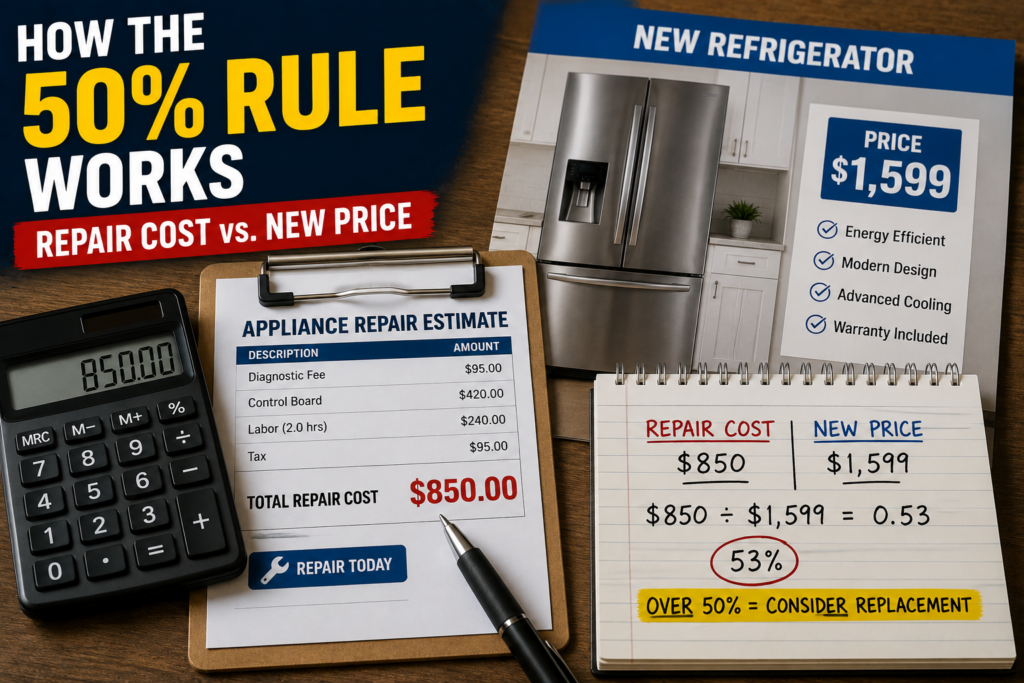
Alt Text: Technician comparing appliance repair costs with the price of a new appliance using a calculator.
What Is the 50% Rule?
The 50% Rule is a simple budgeting guideline used by many appliance technicians and homeowners.
The idea is straightforward:
If the repair will cost at least half the price of buying a similar new appliance, replacement is often the better long-term investment.
For example:
- New refrigerator: $1,600
- Repair estimate: $850
Since the repair exceeds 50% of the replacement cost, replacing the refrigerator is generally the more practical option.
The rule isn’t absolute, but it helps prevent spending large amounts on appliances that may soon require additional repairs.
Why the 50% Rule Makes Sense
Major appliance repairs can become expensive quickly.
A homeowner may replace one failed component only to experience another unrelated failure a few months later.
Instead of looking only at today’s repair bill, the 50% Rule encourages thinking about the appliance’s remaining value.
It asks an important question:
Will this repair likely provide several more years of dependable service?
If the answer is uncertain, replacement often becomes the smarter financial choice.
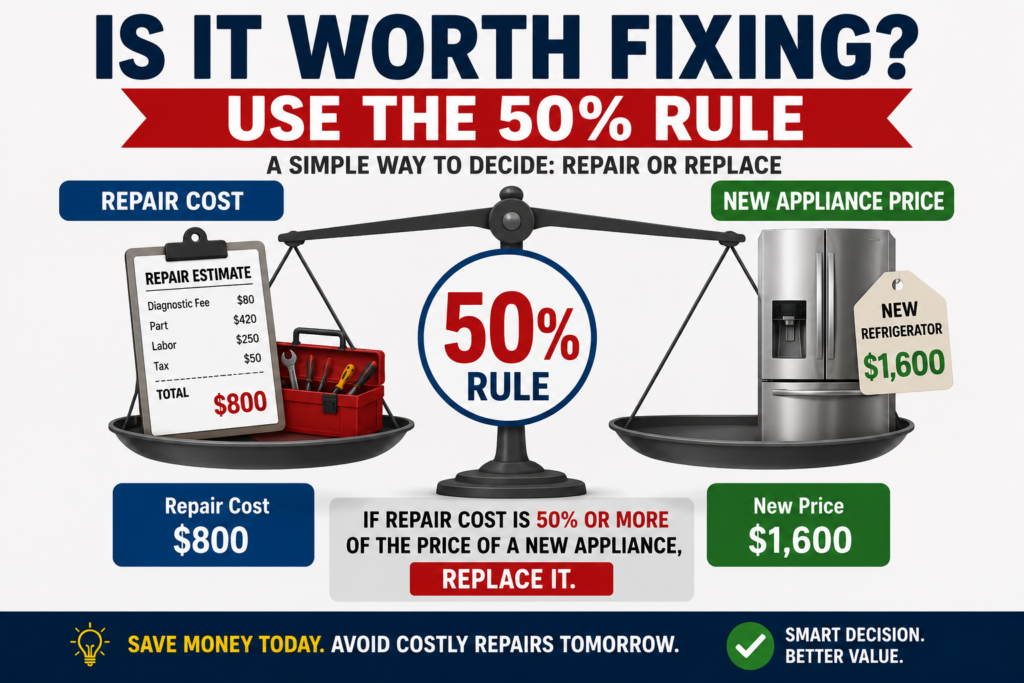
Alt Text: Infographic showing a repair cost compared with the price of a new appliance using the 50% Rule.
Age Matters Just as Much as Repair Cost
Repair cost alone shouldn’t determine your decision.
Consider the appliance’s current age compared with its typical lifespan.
| Appliance | Average Lifespan |
|---|---|
| Refrigerator | 10–15 years |
| Dishwasher | 9–12 years |
| Washing Machine | 10–14 years |
| Dryer | 12–15 years |
| Electric Range | 13–15 years |
| Microwave | 7–10 years |
For example:
A 13-year-old refrigerator needing an $800 repair presents a much different situation than a 3-year-old refrigerator with the same repair estimate.
Older appliances naturally carry a higher risk of future breakdowns.
When Repair Usually Makes Sense
Repair is often the better option if:
- The appliance is still relatively new.
- It’s been reliable until now.
- Only one major component has failed.
- Replacement parts remain widely available.
- Repair costs stay well below the 50% threshold.
Many control boards, water pumps, heating elements, and door switches can be replaced successfully without shortening the appliance’s remaining lifespan.

Alt Text: Side-by-side comparison of a repair technician fixing an appliance versus a new appliance being delivered.
When Replacement Is Usually the Better Choice
Replacement becomes more attractive when multiple warning signs appear.
Consider replacing your appliance if:
- Repair costs exceed 50% of replacement cost.
- The appliance is nearing the end of its expected life.
- Multiple repairs have occurred within the past few years.
- Replacement parts are discontinued.
- Energy efficiency has improved significantly since purchase.
- Repair appointments are becoming increasingly frequent.
Spending hundreds of dollars repeatedly often costs more than replacing the appliance once.
Don’t Forget Operating Costs
Older appliances often consume more electricity and water than modern models.
Although energy savings alone rarely justify immediate replacement, they can influence the decision when major repairs are already needed.
For example:
- New refrigerators typically use far less electricity than units built 15–20 years ago.
- Modern dishwashers clean effectively using much less water.
- New washing machines often reduce both water and utility costs over time.
Lower operating costs can offset part of the purchase price during the appliance’s lifetime.
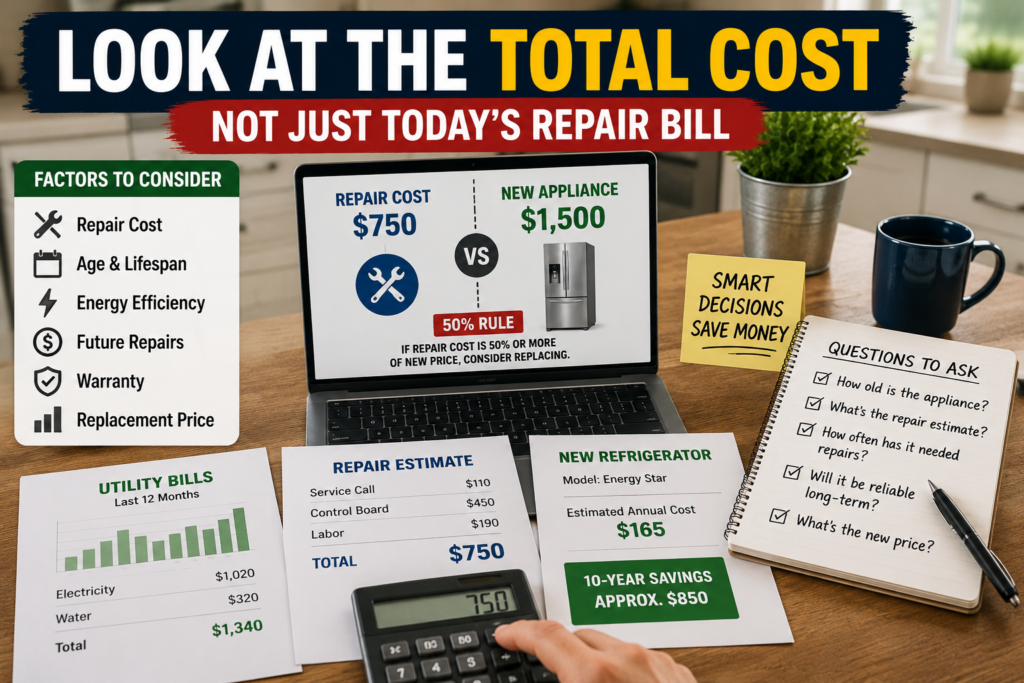
Alt Text: Homeowner comparing utility bills, appliance repair estimates, and prices for a new energy-efficient appliance.
Questions to Ask Before Deciding
Before approving a repair estimate, ask yourself:
- How old is the appliance?
- Has it required previous major repairs?
- What caused the failure?
- Are replacement parts still available?
- How much would a similar new model cost?
- Will this repair likely solve the problem for several more years?
Answering these questions usually makes the decision much clearer.
The 50% Rule Isn’t Perfect
The rule is a guideline—not a guarantee.
Sometimes repairing an expensive built-in refrigerator costing several thousand dollars makes more sense than replacing it, even when repairs exceed 50%.
Likewise, replacing a budget appliance may be smarter even if repairs cost less than half its replacement value.
Every decision should balance:
- Repair cost
- Appliance age
- Reliability history
- Future repair risk
- Replacement price
- Energy efficiency
- Personal budget
The 50% Rule simply provides an excellent starting point instead of relying on emotion or guesswork.
Repair or Replace? A Practical Way to Decide
If your appliance is relatively young, dependable, and facing its first major repair, fixing it is often the economical choice.
If it’s already nearing the end of its lifespan and the repair approaches half the cost of a comparable replacement, investing in a new appliance usually offers better long-term value, improved efficiency, and greater reliability.
Frequently Asked Questions
Does the 50% Rule apply to every appliance?
Yes, it can be used as a general guideline for refrigerators, washers, dryers, dishwashers, ovens, and similar household appliances. However, high-end or built-in appliances may require additional consideration because replacement costs are much higher.
Should I replace an appliance after one expensive repair?
Not necessarily. If the appliance is relatively new and has otherwise been reliable, one major repair may still be worthwhile.
What if replacement parts are no longer available?
When essential parts have been discontinued, replacement is usually the only practical option regardless of repair cost.
Is energy efficiency enough reason to replace an appliance?
Usually not by itself. However, when combined with high repair costs and advanced age, better efficiency can strengthen the case for replacement.
Repair or Replace Checklist
- Compare the repair estimate with the price of a similar new appliance.
- Check whether the repair exceeds roughly 50% of replacement cost.
- Consider the appliance’s age and expected lifespan.
- Review its repair history over the past several years.
- Factor in future energy savings and maintenance costs.
- Choose the option that provides the best long-term value rather than the lowest immediate expense.
Related Reading:
• The Best Time of Year to Buy Home Appliances (Save Hundreds on Your Next Purchase)
• Should You Buy Appliance Extended Warranties? The Truth About Protection Plans
• Why New Appliances Don’t Last as Long as Older Models: The Real Reasons
• Are Korean Appliances Worth Buying in America? LG and Samsung vs U.S. Brands