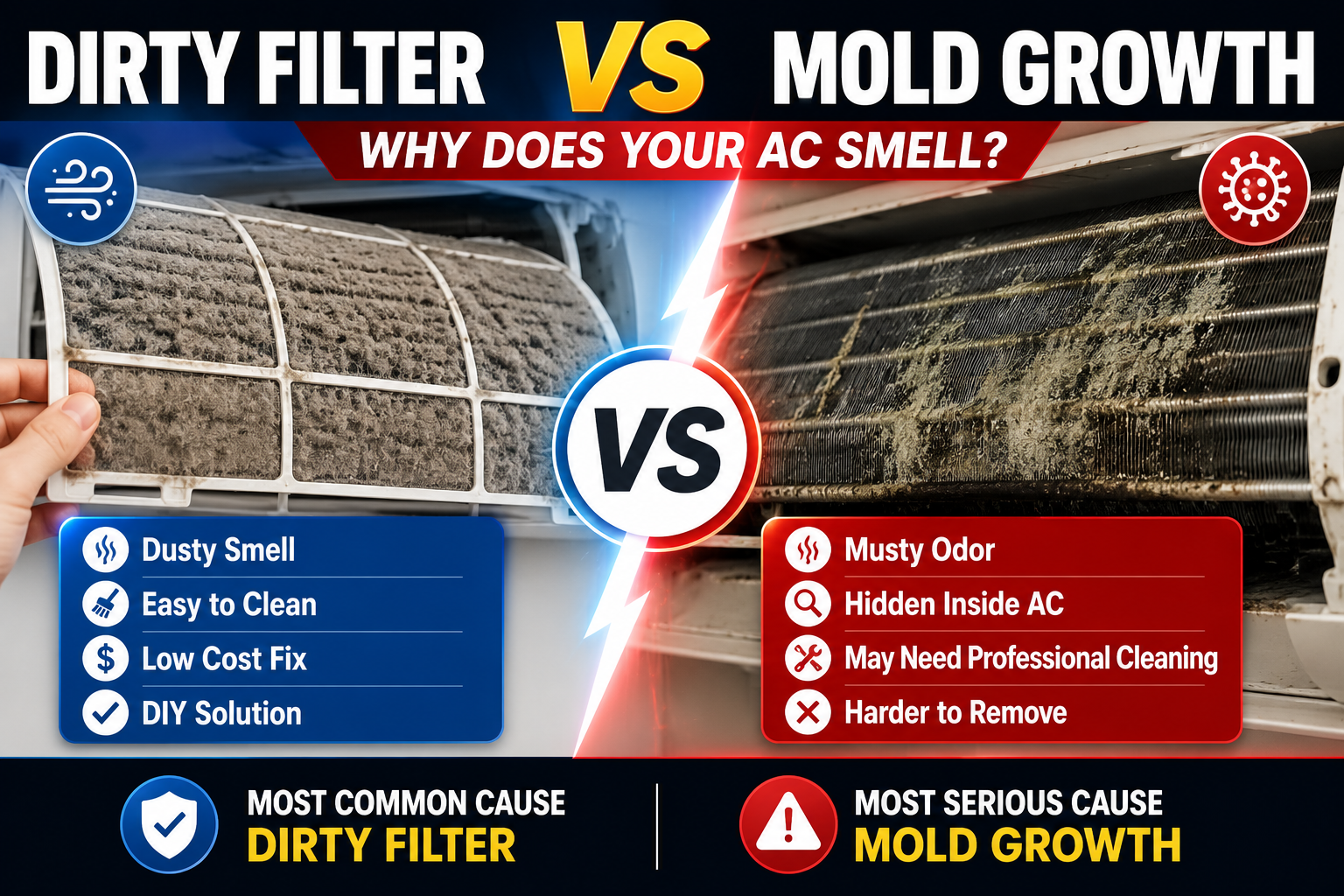
Why Does Your Air Conditioner Smell? Dirty Filter vs Mold Growth Explained
Few things are more frustrating than turning on your air conditioner on a hot summer day and being greeted by a strange smell.
Many homeowners assume a dirty air filter is the problem. While that’s often true, unpleasant AC odors can also be caused by mold growing inside the system.
The challenge is that both problems can produce similar symptoms, but they require very different solutions.
Understanding the difference can save you time, money, and unnecessary repairs.
In this guide, we’ll compare dirty air filters and mold growth, explain how to identify the source of the smell, and show you the best ways to fix it.
Quick Answer
A Dirty Filter Is More Likely If:
✅ The smell resembles dust or stale air
✅ Airflow feels weaker than usual
✅ The filter hasn’t been cleaned recently
✅ The odor improves after cleaning the filter
Mold Growth Is More Likely If:
✅ The smell is musty or sour
✅ The odor appears immediately when the AC starts
✅ Cleaning the filter doesn’t help
✅ You notice black spots inside vents
What’s the Biggest Difference?
The main difference is location.
A dirty filter is usually a surface-level issue caused by dust and debris near the air intake.
Mold growth typically develops deeper inside the air conditioner where moisture collects, making it harder to remove without a thorough cleaning.
Dirty Air Filter: Causes and Symptoms
Your AC filter is designed to capture:
- Dust
- Pet hair
- Pollen
- Airborne particles
Over time, these contaminants build up and can create unpleasant odors.
Benefits of Fixing a Dirty Filter
✅ Easy DIY maintenance
✅ Low cost
✅ Improved airflow
✅ Better cooling performance
✅ Immediate results in many cases
Drawbacks of Ignoring It
❌ Reduced cooling efficiency
❌ Higher energy bills
❌ Poor indoor air quality
❌ Potential mold growth if left untreated
Common Filter Smells
Most dirty filters create odors similar to:
- Dust
- Old air
- Stale rooms
- Mild mustiness
If the smell isn’t particularly strong, the filter should be your first inspection point.
Mold Growth Inside the AC
Mold thrives in dark, damp environments.
Air conditioners naturally create condensation, making components such as evaporator coils and blower fans potential breeding grounds.
Areas Where Mold Commonly Develops
- Evaporator coils
- Drain pans
- Blower fans
- Air ducts
- Interior housing
Because these areas are difficult to reach, mold problems often go unnoticed for months.
Benefits of Removing Mold
✅ Better indoor air quality
✅ Elimination of unpleasant odors
✅ Improved cooling efficiency
✅ Healthier environment for sensitive individuals
Challenges
❌ More difficult to clean
❌ Professional service may be required
❌ Can return if moisture isn’t controlled
❌ Costs more than simple filter maintenance
Dirty Filter vs Mold Growth Comparison
| Category | Dirty Filter | Mold Growth |
|---|---|---|
| Smell Type | Dusty, stale | Musty, sour, mildew-like |
| Location | Air filter, intake area | Internal components |
| Difficulty | Easy | Moderate to difficult |
| DIY Repair | Usually possible | Limited |
| Cost | Minimal | May require professional cleaning |
| Recurrence | Poor maintenance | Moisture problems |
| Best Solution | Filter cleaning or replacement | Deep cleaning and mold removal |
How to Identify the Source of the Smell
The type of odor often provides the biggest clue.
Likely a Dirty Filter
- Dust smell
- Stale air smell
- Weak airflow
- Visible dirt on the filter
Likely Mold Growth
- Wet towel smell
- Musty odor
- Sour smell
- Persistent odor after filter cleaning
If the smell continues even after replacing the filter, mold becomes much more likely.
How to Fix Each Problem
For Dirty Filters
- Remove the filter
- Vacuum loose debris
- Wash reusable filters
- Allow the filter to dry completely
- Reinstall or replace if necessary
Many homeowners notice improvement immediately after cleaning.
For Mold Problems
Mold often develops in areas that cannot be safely accessed without partially disassembling the unit.
While AC cleaning sprays may help with mild contamination, severe mold buildup often requires professional cleaning.
If you see black spots inside vents or smell mildew every time the system starts, professional service may be the safest solution.
How to Prevent Air Conditioner Odors
The best prevention strategy is moisture control.
Tips to Reduce Odor Problems
✅ Use Auto Clean or Self-Clean features
✅ Run fan mode for several minutes before shutting down
✅ Clean filters regularly
✅ Keep drain lines clear
✅ Schedule periodic maintenance
These simple habits can significantly reduce mold growth inside the system.
When Should You Call a Professional?
Consider professional AC cleaning if:
🔧 Filter cleaning doesn’t solve the problem
🔧 Strong musty odors continue
🔧 Black spots are visible inside vents
🔧 Family members suffer from allergies or asthma
🔧 The unit hasn’t been professionally cleaned in years
Professional cleaning is often the fastest way to eliminate deeply embedded mold and restore airflow.
Final Verdict
If your air conditioner smells dusty or stale, a dirty air filter is usually the culprit and can often be fixed with simple cleaning.
If the odor smells musty, sour, or similar to a damp towel—and continues after cleaning the filter—mold growth inside the unit becomes much more likely.
The key isn’t simply cleaning the air conditioner.
It’s identifying the source of the odor first.
Once you know whether you’re dealing with a dirty filter or mold buildup, choosing the right solution becomes much easier.