
Comparing LG vs Whirlpool refrigerators is more useful when you compare model numbers, not brand personalities. This guide puts two U.S. counter-depth French-door models side by side, then checks the details that can change a purchase: storage, installed fit, electricity use, and repair coverage. The warranty comparison distinguishes general coverage from sealed-system and compressor coverage. [1] [3] [6] [8]
This is a document-based comparison, not a hands-on test or a ranking of either brand’s entire range. We have not verified comparable failure-rate data for these two models. Calculations and shopping checklists below are our own analysis of the cited documents.
The Two Models Compared Here
We selected the LG LRFLC2706S and Whirlpool WRFC2036RZ because both are marketed as counter-depth French-door refrigerators with internal water dispensing. They are not equal-capacity alternatives. Treat this as a worked comparison, not a claim that these are the only worthwhile models or that either is available in your ZIP code. [1] [3]
| Published specification | LG LRFLC2706S | Whirlpool WRFC2036RZ |
|---|---|---|
| Total capacity | 26.5 cu. ft.; marketed as 27 | 20.0 cu. ft. |
| Width | 35 3/4 inches | 35 5/8 inches |
| Published top height | 70 1/4 inches to door hinge | 70 1/8 inches overall |
| Water dispenser | Inside the refrigerator | Inside the refrigerator |
| Annual electricity figure | 632 kWh in LG’s specification sheet | 563 kWh on Whirlpool’s EnergyGuide |
Sources: LG’s model specification sheet, Whirlpool’s product page and model-family dimension sheet, and the WRFC2036R-series EnergyGuide. Dimensions are appliance measurements, not complete installation-opening requirements. [2] [3] [4] [5]
The stated capacity difference is 6.5 cu. ft., calculated from the table. That is a reason to inspect your storage needs, not a measured claim about how many grocery bags will fit. Bring the dimensions of frequently used trays, bottles, and containers to the showroom.
Counter-Depth Does Not Mean Identical Fit
LG’s specification sheet lists a depth of 31 5/8 inches including handles and 29 1/8 inches without handles. It separately specifies installation clearances of 1/8 inch at the sides, 1 inch above, and 2 inches behind. Do not use cabinet depth alone to plan the finished installation. [2]
A Whirlpool Depth Discrepancy to Resolve Before Ordering
At review, Whirlpool’s product page displayed 29.375 inches as its depth. The manufacturer’s dimension sheet linked for WRFC2036RZ by Lowe’s instead lists 30.5 inches with handles for the WRFC2036R family. The page and sheet do not give us enough information to explain that difference confidently. [3] [4] [12]
Do not design cabinetry around either figure without confirmation. Ask Whirlpool or the installer for the current drawing for the exact model and supplied handles, including closed depth, door swing, drawer extension, and rear connections. The family sheet also calls for ventilation and wall clearances; fitting the cabinet into the opening is only part of the check. [4]
Our suggested fit test is to mark the appliance footprint and door swing on the floor. Check the delivery route, nearby wall, island, and whether drawers can be removed for cleaning. Keep a copy of the drawing used for the order.
Compare the Layout You Will Use Every Day
On the LG model, the published features include an internal water dispenser, ice maker, and ThinQ Care. Its specification sheet lists Wi-Fi and remote monitoring. Verify the exact app functions you want rather than assuming that connectivity includes an interior camera or every feature advertised on other LG models. [1] [2]
The Whirlpool model’s documented features include adjustable shelves and gallon door bins, an elevated deli drawer, and two-tier freezer storage. Try those arrangements with your usual groceries in mind. Neither adjustable shelving nor the absence of a feature you do not need proves a longer appliance lifespan. [3]
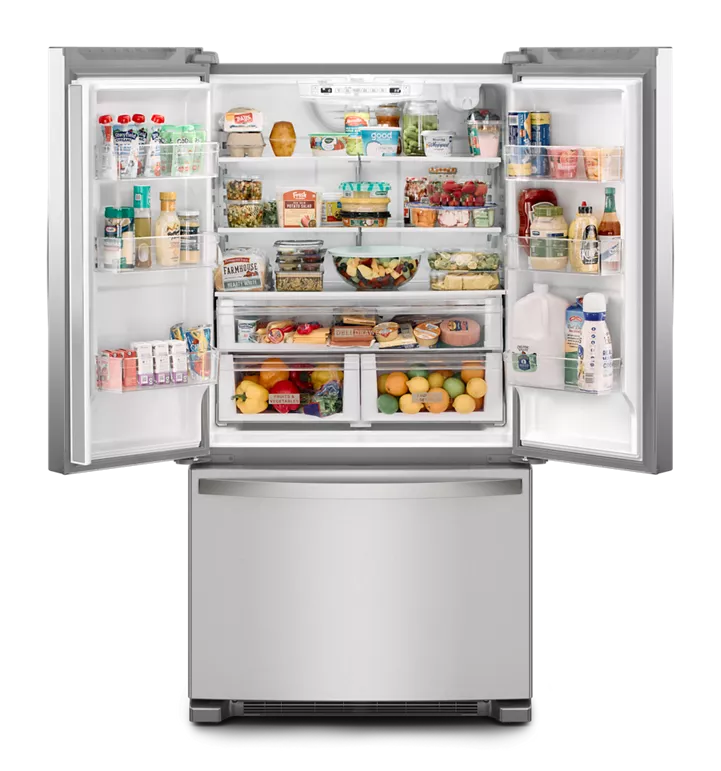
For a showroom visit, our suggested checks are simple: reach the dispenser, move a shelf, load a tall container, and open the freezer drawer with the refrigerator doors positioned as they would be at home. A preferred layout is a personal fit judgment, not a brand-wide quality score.
LG vs Whirlpool Refrigerators: Read Parts and Labor Separately
The general one-year term is not the whole warranty. LG’s support page for LRFLC2706S lists five years of parts and labor for the sealed system and separate compressor coverage. The Whirlpool warranty document linked for WRFC2036RZ includes parts and labor for specified sealed-system repairs in years two through five. These are model/document comparisons, not terms for every refrigerator from either brand. [6] [8]
| Coverage category | LG LRFLC2706S | Whirlpool document linked for WRFC2036RZ |
|---|---|---|
| General limited warranty, excluding promotions | 1 year, parts and labor | 1 year, parts and labor |
| Sealed refrigeration system | 5 years, parts and labor for the listed components | Years 2–5: specified parts and labor after first-year coverage |
| Compressor coverage after year 5 | Years 6–10: eligible compressor parts only; labor not included | Not included in the document reviewed |
Read this as a summary of qualifying defect coverage, subject to exclusions, not a promise of free repair for any problem. LG’s model support page and warranty PDF are hosted by LG. Whirlpool’s manufacturer-issued warranty W11655299A is hosted by Lowe’s and linked in the exact model’s documentation section. Confirm the warranty supplied with your purchase. [6] [7] [8] [12]
Why “10-Year Compressor Warranty” Is Not Ten Years of Free Repairs
LG’s warranty distinguishes compressor parts from labor in the later years. An eligible replacement compressor may be covered while labor remains chargeable. Other components are not automatically covered by that longer compressor term. Ask for a written breakdown of covered and customer-paid costs before approving work. [7]
Promotions must be checked separately. At review, LG’s product page advertised a two-year limited-warranty offer on eligible purchases from April 9 through December 31, 2026, with ThinQ app and Wi-Fi requirements. Do not assume that an advertisement changes every warranty category or applies to every purchase. Check the current offer terms and keep proof of eligibility. [1]
Compare Electricity Using the Same Rate
For this example, use the published annual figures in the first table and an assumed electricity price of $0.20 per kWh. This is our calculation, not a measurement of either refrigerator in a home:
- LG: 632 × $0.20 = $126.40 per year.
- Whirlpool: 563 × $0.20 = $112.60 per year.
- Calculated difference: $13.80 per year.
The inputs come from LG’s specification sheet and Whirlpool’s model-family EnergyGuide. The Whirlpool label itself uses 14 cents per kWh for its printed dollar estimate; using one assumed rate avoids mixing electricity prices. [2] [5]
These refrigerators have different capacities, so the result does not establish which brand is more energy-efficient. FTC guidance recommends comparing similar appliances and explains that actual costs depend on your rate and use. Treat the figures as budgeting inputs, not a guaranteed bill or a performance ranking. [9]
Reliability, Local Service, and the Final Choice
We have not verified a same-method, same-period failure-rate comparison for these exact models. This article therefore does not label either one more reliable, quieter, or longer-lasting. Brand reputation, a long warranty, and a list of features are not substitutes for that evidence.
Use the LG service locator or Whirlpool service portal to start checking local support. Then confirm with the provider that it handles your exact model and the type of work required. A locator entry alone does not establish appointment availability or parts stock. [10] [11]
Which One Belongs on Your Shortlist?
For a household prioritizing capacity: our model comparison points toward inspecting the LG’s larger stated storage first, provided the full installation fits. That is a capacity-based shortlist, not an overall quality verdict. [2]
For a household comfortable with a smaller compartment: inspect the Whirlpool layout and lower published annual electricity figure, but resolve the depth discrepancy before committing. Lower estimated electricity use alone does not justify a higher total purchase cost. [3] [4] [5]
For a buyer primarily worried about repairs: compare local service and out-of-pocket exposure rather than choosing a brand from anecdotes. Ask what is covered for the part, labor, diagnosis, travel, and access to the appliance. These are our suggested questions, not a claim that all those charges apply to every repair.
Get Comparable Written Quotes
Our suggested quote checklist includes the exact model and finish, tax, delivery, installation, water-line work, old-appliance removal, and any optional service plan. Record whether a discount requires buying other appliances. Keep the warranty, EnergyGuide, installation drawing, and dated quote together.
If you are replacing a refrigerator because one compartment is warm, our guide to a warm refrigerator with a still-cold freezer explains food protection and safe preliminary checks. A replacement decision should follow the actual diagnosis, not a guessed component failure.
Choose the model that fits your opening, storage needs, budget, and service situation. This comparison gives you documented differences and one unresolved fit question to take to the seller; it does not turn either badge into a universal recommendation.
Official and Manufacturer-Authored Sources
Sources reviewed September 18, 2026. Specifications refer to the named U.S. models. Manufacturer PDFs may have earlier revision dates; use the current documents supplied for the exact appliance when ordering. Two Whirlpool documents below are manufacturer-authored PDFs hosted by Lowe’s, not retailer-written warranty summaries.
[1] LG: LRFLC2706S Product Page and Promotional Terms
https://www.lg.com/us/refrigerators/lg-lrflc2706s-french-3-door-refrigerator
[2] LG: LRFLC2706S Pro Builder Specification Sheet (PDF)
https://www.lg.com/us/business/download/resources/CT00021979/LRFLC2706S_LG_Pro_Builder_Spec_Sheet%5B20240531_231311%5D.pdf
[3] Whirlpool: WRFC2036RZ Product Page
https://www.whirlpool.com/kitchen/refrigeration/refrigerators/french-door/p.36-inch-wide-counter-depth-french-door-bottom-mount-refrigerator-20-cu.-ft.wrfc2036rz.html
[4] Whirlpool: WRFC2036R-Series Dimension Guide (Manufacturer PDF Hosted by Lowe’s)
https://pdf.lowes.com/productdocuments/a24449b3-9635-466b-875f-8b8d11039ce3/68462724.pdf
[5] Whirlpool: WRFC2036R-Series EnergyGuide (PDF)
https://www.whirlpool.com/content/dam/global/documents/202406/energy-guide-w11730575-revB.pdf
[6] LG: LRFLC2706S Model Support and Warranty Summary
https://www.lg.com/us/support/product/lg-LRFLC2706S.ASTCNA0
[7] LG: U.S. Refrigerator Limited Warranty (PDF)
https://www.lg.com/us/PDF/warranty/ha/Warranty_REF.pdf
[8] Whirlpool: Limited Warranty W11655299A (Manufacturer PDF Hosted by Lowe’s; English Coverage on PDF Pages 3–4)
https://pdf.lowes.com/productdocuments/1fd081a3-3dd3-42b9-93d8-fa7d362fd84e/69000083.pdf
[9] Federal Trade Commission: How to Use the EnergyGuide Label
https://consumer.ftc.gov/articles/how-use-energyguide-label-shop-home-appliances
[10] LG: Find a Service Center
https://www.lg.com/us/support/find-service-center
[11] Whirlpool: Service Portal
https://service.whirlpool.com/
[12] Lowe’s: WRFC2036RZ Listing and Manufacturer Document Links
https://www.lowes.com/pd/Whirlpool-Whirlpool-Counter-Depth-French-Door-Bottom-Mount-Refrigerator/5015683209
About this comparison: Published by JJINGOSU as a source-based buying guide. About JJINGOSU.