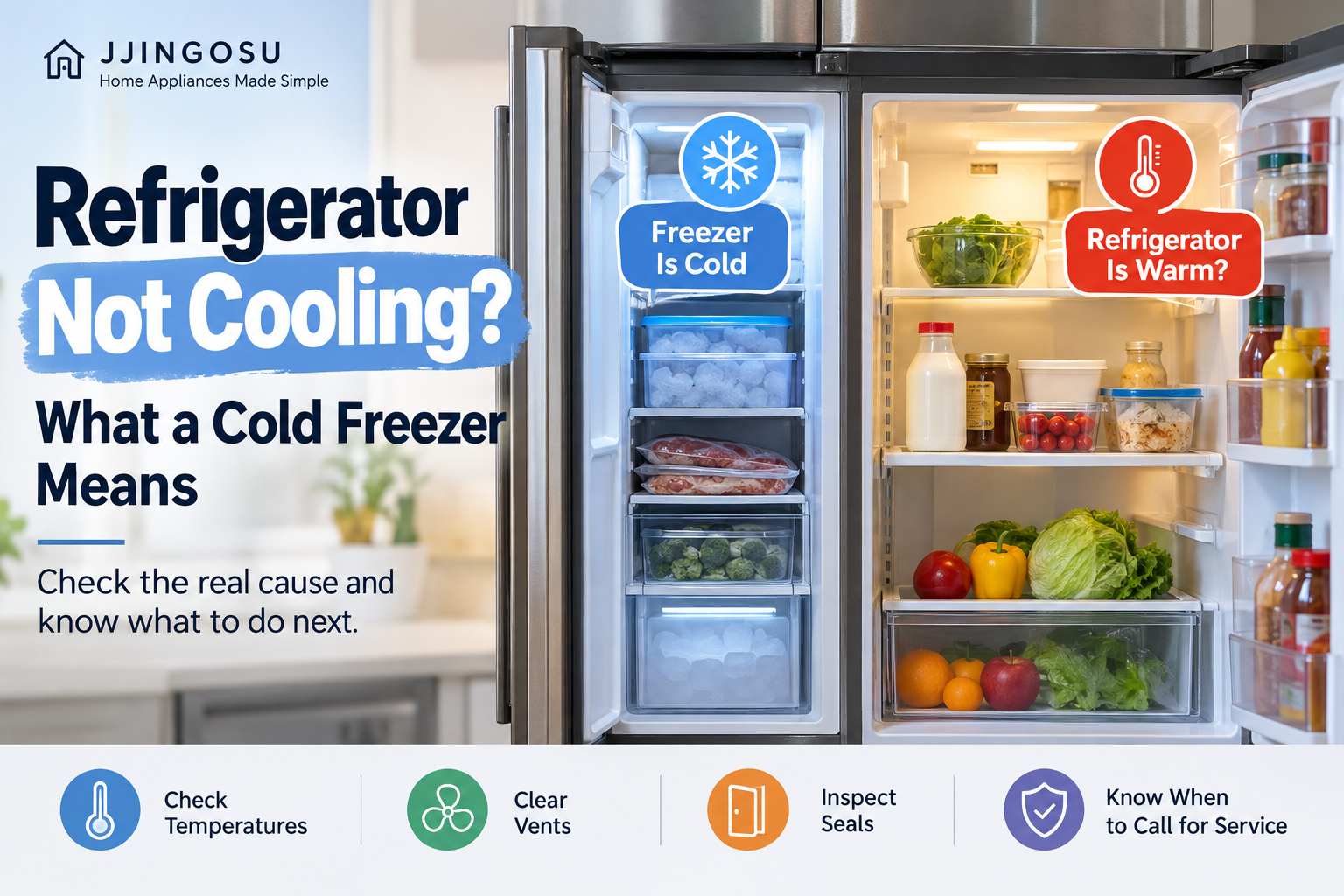
Refrigerator not cooling while the freezer still seems cold? Start with temperature measurements and food protection, not a replacement part. Blocked vents are worth checking on shared-airflow models, but refrigerators with separate evaporators need a different interpretation. A cold freezer alone does not establish that every cooling component is healthy. [1] [3] [4]
This guide combines U.S. manufacturer instructions with federal food-safety guidance. The checking order is based on safe access, not an unsupported ranking of failure rates. It is not a hands-on test or a model-specific repair manual.
Protect the Food Before Waiting for Cooling
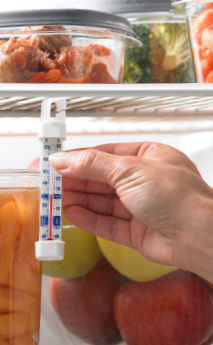
Use appliance thermometers to check both compartments. FDA guidance is 40°F (4°C) or below in the refrigerator and 0°F (-18°C) in the freezer. The control-panel setting is not a substitute for measuring the actual temperature. [1]
If the fresh-food compartment cannot keep perishables safely cold, move them promptly to a working refrigerator or a cooler with enough ice to maintain a safe temperature. Do not leave milk, meat, eggs, or leftovers in a warm compartment while troubleshooting. [1]
FoodSafety.gov’s temperature-exposure chart calls for discarding foods such as meat, milk, eggs, and leftovers after more than two hours at 40°F or above. Different foods have different rules, so use the food-by-food chart rather than automatically discarding everything. If the temperature history of a perishable food is unknown, do not gamble on it. Never taste food to judge safety. [1] [2]
The four-hour guideline for an unopened refrigerator during a power outage is not four extra hours once you discover a warm fridge. Temperature exposure may have started earlier. This distinction matters when a cooling failure develops unnoticed. [2]
Confirm What “The Freezer Is Cold” Actually Means
Follow each thermometer’s placement and reading instructions, keep door openings brief, and record both readings with the time. Do not use the feel of a package as a substitute for a temperature measurement. [1]
| What you find | How to use that information |
|---|---|
| The freezer is near its proper temperature, but the fridge is too warm. | Identify the cooling design, then check fresh-food settings, airflow, and door closure. |
| Both compartments are above their intended temperatures. | Treat this as a broader cooling problem. A freezer that merely feels cold is not confirmed healthy. |
| Some refrigerator items freeze while others stay warm. | Check food placement and obstructed vents before repeatedly changing temperature settings. |
| Heavy frost, scraping, or an error message accompanies the temperature problem. | Photograph the frost or code. Use the model’s support guidance rather than buying a part from the symptom alone. |
This table is a troubleshooting starting point, not a component diagnosis. It combines the manufacturers’ airflow, cooling, frost, and error-code guidance. [3] [5] [6] [10]
Check How Your Model Cools Each Compartment
Shared Airflow from the Freezer
In the conventional design described by GE, one evaporator cools the freezer and cold air is directed into the refrigerator. Whirlpool explains that supply and return vents allow that air to circulate. Blocking either route can disturb cooling even when the freezer remains cold. [3] [4]
Separate Evaporators
Other designs cool the compartments separately. GE’s ClimateKeeper dual-evaporator system, for example, uses an evaporator in each compartment without mixing their air. For that design, do not assume the refrigerator depends on freezer air passing through a connecting damper. [4]
Check the model number against its manual or manufacturer specifications. Cabinet style and visible vent openings alone are not a reliable way to identify the system. Clear fresh-food vents on either design: independent cooling does not make internal air circulation unnecessary. [4] [5]
The practical conclusion: the cold-freezer symptom helps choose a troubleshooting path, but it does not rule out every compressor or refrigerant-system problem. Separate cooling paths change what must be checked, and stored food can remain cold for a while even when active cooling has stopped. [2] [4]
Start with Checks That Do Not Require Disassembly
Keep this inspection to accessible controls, food placement, seals, and maintenance specifically permitted in your manual. Disconnect power before approved coil cleaning. Do not disturb water lines, wiring, refrigerant tubing, or internal fan assemblies. [9]
Record Codes Before Changing Settings
Photograph any error code or blinking display first. Samsung warns against clearing codes or unplugging solely to hide an error unless directed, because doing so can make diagnosis harder. Use the instructions for that exact code and model, not a generic reset sequence. [10]
Check the refrigerator compartment’s setting and cooling mode. A number on a dial may represent a cooling level rather than degrees, so “turn it lower” is not universal advice. GE distinguishes numbered controls from actual-temperature controls in its adjustment instructions. [11]
Clear Supply and Return Vents
Locate the vents shown in the manual and move containers, bags, and trays away from them. Check both compartments on a shared-airflow model. Leave the model’s specified clearance instead of assuming every refrigerator needs the same gap. [3]
Do not insert tools into the openings or force a visible flap. If you can see ice rather than food blocking a vent, photograph it and move to the frost guidance below. Whirlpool notes that items directly in cold incoming airflow can freeze; moving sensitive foods away from that stream may help with uneven temperatures. [3] [6]
Check Doors, Drawers, and Seals
Make sure a shelf, drawer, large container, or door-bin item is not preventing full closure. Inspect the gasket all the way around for residue, tears, or gaps. Samsung recommends warm soapy water and a soft cloth for cleaning a dirty seal, followed by drying. [6] [11]
A paper-in-the-door test can identify a loose area, but it is not a complete gasket diagnosis. Samsung notes that door misalignment can also make the test fail. Clean first; arrange adjustment or service if a gap remains instead of automatically ordering a seal. [5]
Check the Installation and Approved Coil Maintenance
Compare room temperature and cabinet clearances with the installation manual, particularly after a move or installation in a garage. GE cautions that an unsuitable location or inadequate air clearance can affect cooling. Do not apply one brand’s clearance or ambient-temperature range to every model. [11]
For condenser cleaning, check the manual before removing anything. Whirlpool says some models need no routine coil cleaning and others require a certified technician. Where owner cleaning is permitted, disconnect power, use the specified soft brush or vacuum method, avoid damaging tubing or fins, and refit the grille before restoring power. [9]
Skip this step when access requires undocumented panel removal or moving a heavy built-in unit. A fixed “clean every six months” rule is not appropriate for every refrigerator; use its maintenance instructions. [9]
Frost and Fan Noise Are Clues, Not Part Diagnoses
Inspect visible surfaces only. Heavy frost on a rear wall or around a vent deserves attention, but it does not identify a particular heater, sensor, or board. Warm air entering through a door gap can also produce frost. GE recommends technician assessment for heavy ice accumulation on automatic-defrost models. [6] [8]
Silence during a brief check does not establish a failed fan. GE explains that fans and the compressor stop during automatic defrost. Samsung also documents fan noise that stops when a door opens. Do not bypass a door switch, remove an evaporator cover, or reach for a fan blade to force a test. [7] [8]
Should You Unplug It to Melt the Ice?
Not as a universal first step. For Samsung’s documented fan-hitting-ice condition, manual defrosting may silence the noise temporarily, but service is needed to correct its cause. Improvement after thawing is useful history; it is not proof that one specific defrost part failed. [7]
If your manual or service provider recommends manual defrosting, protect the food first and follow that procedure. Do not use a hair dryer, heat gun, knife, or other improvised method to attack ice. Samsung explicitly warns against added heat. Do not put perishables back until safe storage temperatures are restored. [1] [7]
Refrigerator Not Cooling After the Basic Checks?
After an adjustment, follow the model’s stabilization instructions and monitor the temperature trend. Whirlpool’s vent-and-control guide allows 24 hours between temperature adjustments. That is an appliance adjustment interval, not permission to leave perishables warm for a day. Keep food elsewhere while the compartment is unsafe. [3] [2]
Arrange service when cooling does not recover after the permitted checks, heavy frost returns, or a code directs you to service. If the fridge stays warm while the freezer remains at its target, give the technician both measured temperatures and the model number. Do not reduce that report to “the compressor must be fine.” [8] [10] [11]
For burning smells, damaged wiring, or water near electrical connections, stop troubleshooting and seek qualified help. Disconnect power only if it is safe to do so; do not touch a wet plug. This guide does not cover live electrical tests or sealed-system repairs.
A Useful Service Note
Our suggested record is: model and serial number, measured refrigerator and freezer temperatures, time checked, displayed code, recent door or installation changes, visible frost, and what changed after each permitted check. Photographs of the display and visible frost can preserve observations without opening the cabinet.
Ask the technician what test supports the diagnosis, especially before authorizing an expensive electronic or cooling-system part. Request an itemized estimate and check your exact warranty for parts, labor, and service-call coverage. This is a decision checklist, not a claim that any one repair price or replacement-age rule fits every refrigerator.
Bottom line: protect food, measure both compartments, identify the cooling design, and complete only the owner-accessible checks. A still-cold freezer is useful information, not a guarantee of a cheap repair or a healthy sealed system.
Official Sources
Sources reviewed September 17, 2026. Manufacturer examples apply to the designs and models described by those sources; your appliance’s instructions take priority.
[1] FDA: Refrigerator Thermometers — Cold Facts about Food Safety
https://www.fda.gov/food/buy-store-serve-safe-food/refrigerator-thermometers-cold-facts-about-food-safety
[2] FoodSafety.gov: Food Safety During Power Outage
https://www.foodsafety.gov/food-safety-charts/food-safety-during-power-outage
[3] Whirlpool: Checking Air Vents and Airflow
https://producthelp.whirlpool.com/Refrigeration/Full-Size_Refrigerators/Product_Info/Tips_and_Tricks/How_to_Check_the_Air_Vents_for_Blockage_-_Ensuring_Proper_Air_Flow
[4] GE Appliances: ClimateKeeper Dual Evaporator Systems
https://products.geappliances.com/appliance/gea-support-search-content?contentId=21695
[5] Samsung: Refrigerator and Freezer Cooling Issues
https://www.samsung.com/us/support/troubleshoot/TSG10003479/
[6] Samsung: Frost in the Refrigerator or Freezer
https://www.samsung.com/us/support/troubleshoot/TSG10007222/
[7] Samsung: Refrigerator Noises and Fan-Ice Buildup
https://www.samsung.com/us/support/troubleshoot/TSG10007113/
[8] GE Appliances: Automatic Defrost System
https://products.geappliances.com/appliance/gea-support-search-content?contentId=16679
[9] Whirlpool: Safe Condenser Coil Cleaning
https://producthelp.whirlpool.com/Refrigeration/Full-Size_Refrigerators/Product_Info/Cleaning_and_Care/How_and_When_to_Safely_Clean_the_Condenser_Coils
[10] Samsung: Refrigerator Error Codes
https://www.samsung.com/us/support/troubleshoot/TSG10007315/
[11] GE Appliances: Refrigerator Not Cooling Enough
https://products.geappliances.com/appliance/gea-support-search-content?contentId=21185
About this guide: Published by JJINGOSU as a source-based explanation of cooling symptoms and safe owner checks. About JJINGOSU and its editorial approach.