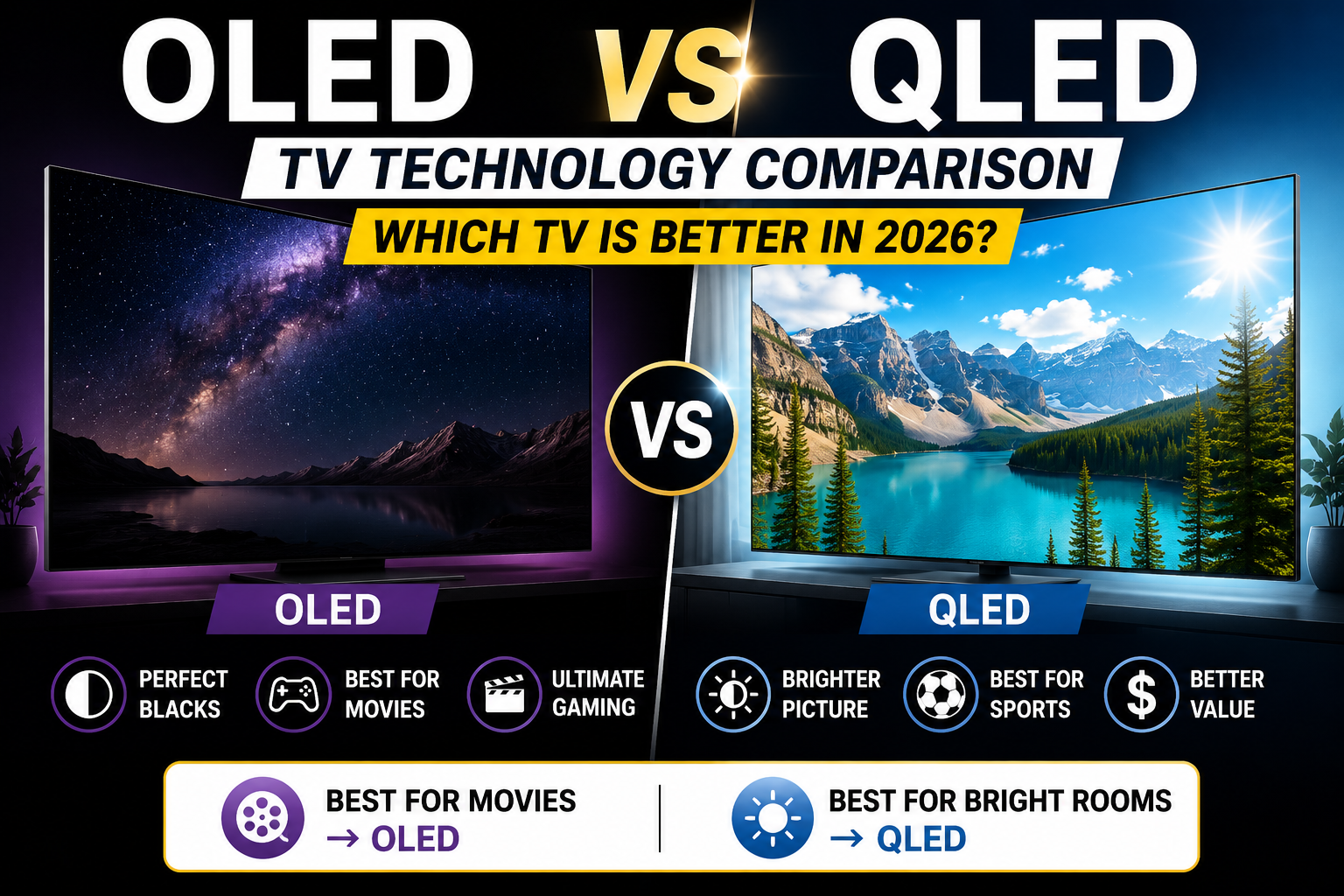
OLED vs QLED: Which TV Technology Is Better in 2026?
If you’re shopping for a new television, you’ve probably come across two terms over and over again:
OLED and QLED.
These are the two most popular premium TV technologies on the market today, and choosing between them can be confusing—especially when both promise incredible picture quality.
The truth is that OLED and QLED are built differently, and those differences can have a major impact on your viewing experience.
Whether you watch movies, play video games, stream Netflix, or spend weekends watching sports, one technology may fit your lifestyle better than the other.
Here’s everything you need to know before buying.
What Is OLED?
OLED stands for Organic Light-Emitting Diode.
Unlike traditional LED TVs, OLED panels do not require a backlight. Each individual pixel produces its own light and can turn completely off when needed.
This gives OLED one major advantage:
🔥 Perfect black levels
Because pixels can switch off individually, dark scenes appear truly black rather than dark gray.
Major OLED TV brands include:
- LG OLED evo
- Samsung OLED
- Sony BRAVIA OLED
OLED Advantages
✅ Perfect black levels
✅ Exceptional contrast
✅ Wide viewing angles
✅ Ultra-fast response times
✅ Excellent gaming performance
✅ Premium home theater experience
OLED Drawbacks
❌ Higher prices
❌ Lower peak brightness than top QLED TVs
❌ Small risk of image retention with long-term static content
What Is QLED?
QLED stands for Quantum Dot Light Emitting Diode.
Unlike OLED, QLED TVs still use a backlight, but they enhance color and brightness using Quantum Dot technology.
This allows QLED displays to achieve extremely bright images while maintaining vivid colors.
Popular QLED models include:
- Samsung Neo QLED
- TCL QLED
- Hisense ULED/QLED
QLED Advantages
✅ Extremely bright picture
✅ Excellent daytime viewing
✅ Vibrant color performance
✅ No meaningful burn-in concerns
✅ Often more affordable in larger sizes
QLED Drawbacks
❌ Black levels are not as deep as OLED
❌ Viewing angles can be more limited
❌ Dark-room movie performance is usually weaker
OLED vs QLED Picture Quality
Picture quality is where most buyers notice the difference.
OLED Wins for Movies
OLED excels in dark environments.
When watching:
- Movies
- TV dramas
- Netflix originals
- HDR content
black areas look deeper and more realistic.
Many movie enthusiasts consider OLED the closest thing to a cinematic experience at home.
QLED Wins for Bright Rooms
QLED shines in rooms with:
- Large windows
- Natural sunlight
- Daytime viewing
Its higher brightness helps images remain vibrant even in challenging lighting conditions.
OLED vs QLED Brightness
This category clearly favors QLED.
OLED
✔ Better contrast
✔ Better black levels
✔ Ideal for dark rooms
QLED
✔ Higher peak brightness
✔ Better daytime performance
✔ Less affected by reflections
If your living room receives lots of sunlight, QLED may be the better choice.
Burn-In: Should You Worry About OLED?
Burn-in is one of the most common concerns among OLED buyers.
Burn-in occurs when static elements remain on screen for extremely long periods.
Examples include:
- News channel logos
- Sports scoreboards
- Static game interfaces
The good news is that modern OLED TVs have significantly improved burn-in protection.
For most households, burn-in is unlikely to become a serious issue.
OLED Is Usually Safe For:
✅ Movies
✅ Streaming
✅ Casual gaming
✅ Everyday TV watching
QLED May Be Better For:
✅ 10+ hours of daily use
✅ Constant news viewing
✅ Commercial displays
✅ Heavy static content
OLED vs QLED for Gaming
Both technologies are excellent for gaming, but OLED has a slight advantage.
Why Gamers Love OLED
🔥 Near-instant response time
🔥 Excellent HDR performance
🔥 Deep contrast
🔥 HDMI 2.1 support
🔥 4K 120Hz gaming
For PlayStation 5 and Xbox Series X owners, OLED remains one of the most recommended options.
Why Some Gamers Prefer QLED
🔥 Higher brightness
🔥 No burn-in concerns
🔥 Better for long gaming sessions
OLED vs QLED for Movies
This category strongly favors OLED.
Why?
Because movies benefit more from:
- Contrast
- Shadow detail
- Black levels
These are areas where OLED continues to dominate.
For home theater enthusiasts, OLED remains the gold standard.
OLED vs QLED Comparison
| Category | OLED | QLED |
|---|---|---|
| Black Levels | ⭐⭐⭐⭐⭐ | ⭐⭐⭐⭐ |
| Contrast | ⭐⭐⭐⭐⭐ | ⭐⭐⭐⭐ |
| Brightness | ⭐⭐⭐⭐ | ⭐⭐⭐⭐⭐ |
| Viewing Angles | ⭐⭐⭐⭐⭐ | ⭐⭐⭐ |
| Gaming | ⭐⭐⭐⭐⭐ | ⭐⭐⭐⭐ |
| Movies | ⭐⭐⭐⭐⭐ | ⭐⭐⭐⭐ |
| Sports | ⭐⭐⭐⭐ | ⭐⭐⭐⭐⭐ |
| Burn-In Resistance | ⭐⭐⭐ | ⭐⭐⭐⭐⭐ |
| Large Screen Value | ⭐⭐⭐ | ⭐⭐⭐⭐⭐ |
Which TV Should You Buy?
Buy OLED If:
✅ Movies are your priority
✅ You watch Netflix frequently
✅ You play console games
✅ You want the best picture quality available
Buy QLED If:
✅ Your room is bright
✅ You watch lots of sports
✅ You keep the TV on all day
✅ Burn-in concerns worry you
✅ You want a larger screen for the money
Final Verdict
Both OLED and QLED deliver excellent picture quality, but they excel in different situations.
🏆 Best for Movies and Home Theater → OLED
🏆 Best for Bright Rooms and Sports → QLED
🏆 Best Overall Picture Quality → OLED
🏆 Best Value for Large Screens → QLED
The best TV isn’t simply the most expensive one.
It’s the one that matches your room, viewing habits, and entertainment preferences.
Still deciding on the right TV size? Check out our 65 vs 75 Inch TV Size Guide to find the best fit for your room.
If you’re comparing actual TV models, don’t miss our LG OLED evo vs Samsung Neo QLED Review for a detailed look at today’s leading premium TVs.
ㅁ