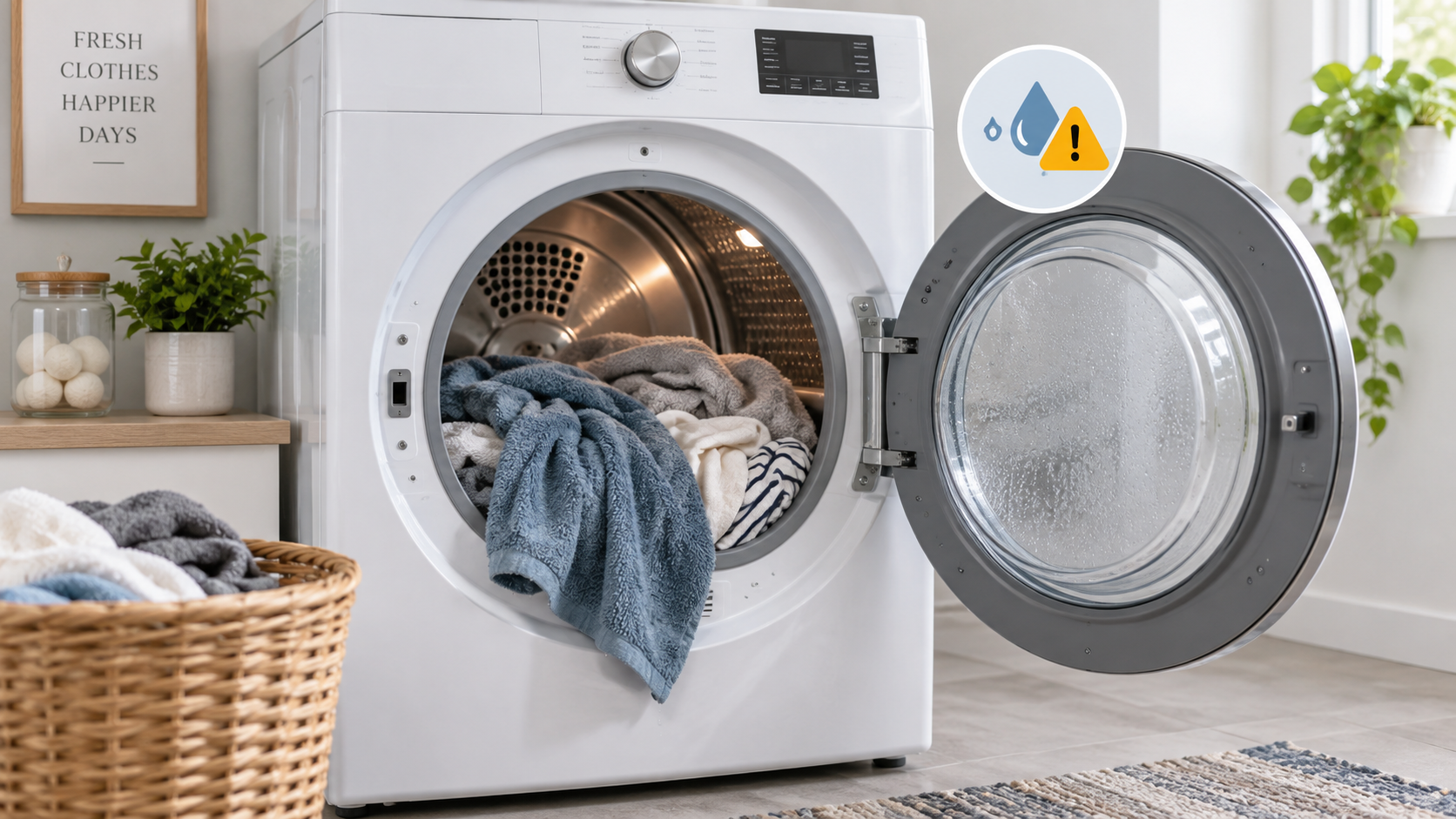
If your dryer takes two cycles to dry clothes, first separate a long-running cycle from one that stops too soon. Warm but damp laundry calls for different checks than a drum that never heats. Start with the load, selected settings, and lint filter; then follow the branch for your dryer type. Damp clothes alone do not identify a failed part. [1] [3]
This guide compares U.S. manufacturer support instructions and public safety guidance. It is not a hands-on repair report. Your model’s owner and installation manuals take priority.
Before You Start Another Cycle
Do not keep restarting a dryer that smells burned, repeatedly overheats, or trips a breaker. Stop using it and get qualified help. For smoke or fire, leave and call 911. If you smell gas or suspect a gas leak, evacuate immediately and call your gas utility or emergency services from a safe location; do not stay to troubleshoot. [11]
For routine inspection only, switch the dryer off, unplug it, and let it cool before cleaning accessible parts. Do not remove cabinet panels, bypass a safety device, or pull out a stacked dryer. Leave work that could disturb a gas connection to a qualified professional. Lint restrictions can cause excessive heat; slow drying is not something to solve indefinitely by adding more time. [5] [6]
Match the Symptom to the Next Check
| What happens | Start here |
|---|---|
| A full cycle ends with warm, damp clothes. | Check the load and filter. On a vented dryer, inspect the exhaust path. |
| Automatic drying ends unusually early. | Check the dryness setting, load size, and moisture sensors. |
| The drum turns but a heated cycle produces no warmth. | Check the selected mode and model-specific power or heating guidance. |
| Laundry was unusually wet before drying. | Check the washer’s spin performance first. |
| The dryer is a ventless heat-pump model. | Use its filter, water collection, and maintenance instructions, not an outdoor exhaust test. |
Use the table to choose a starting point, not to identify a failed part. [3] [7] [8]
Check the Laundry and Settings First
Was the Load Already Too Wet or Too Tightly Packed?
If clothes enter the dryer soaking wet, check whether the washer completed its spin. Use settings permitted by the fabric label. For standing water or failed spinning, see our washer drainage and spin checks. [3]
Leave room for items to tumble. Separate lightweight garments from heavy towels, and check whether bedding has bundled around damp items. Use the manual’s load limit rather than a universal drum-fill percentage. ENERGY STAR notes that oversized loads restrict circulation, while very small loads can also dry inefficiently. [8]
Check the Cycle Name, Not Just the Start Button
On Samsung’s documented models, Air Fluff uses no heat, a timed cycle stops when its set time expires, and a low dryness target can intentionally leave laundry damp. Choose a drying cycle and dryness level suited to the load, while respecting garment care labels. Steam refresh settings are not substitutes for drying a wet wash load. [4]
Energy-saving options can extend the cycle. Samsung’s Eco Dry, for example, reduces energy use partly by reducing heat. A longer programmed cycle is not the same problem as clothes remaining wet after completion. Do not automatically choose maximum heat or disable energy-saving settings unless faster drying is your priority and the fabric permits the alternative. [4]
For Vented Dryers, Follow the Air Path
This section applies to dryers that discharge moist air outdoors. A restricted exhaust path can leave laundry damp and make the cabinet unusually warm, but those observations do not prove where a blockage is located. [2]
Clean the Filter Before Inspecting the Duct
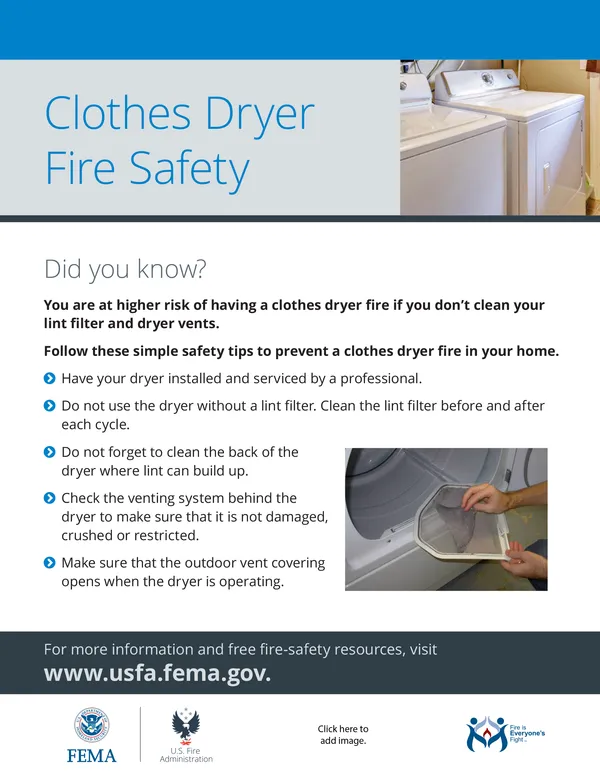
Remove lint from the screen before every load. If residue remains, follow the filter’s cleaning instructions. Whirlpool recommends warm water and a soft brush for softener buildup, followed by thorough drying. Refit the filter securely. Do not run a dryer with a missing or damaged filter. [1] [5]
Look for Crushing, Sharp Bends, and Disconnected Sections
With power disconnected, inspect the visible duct without moving the appliance beyond safe access. A flattened connector, tight bend, or lint accumulation needs attention. A problem that began after installation or moving the machine is a reason to check the duct route rather than immediately ordering a heater. [2]
CPSC recommends replacing plastic or foil accordion-type ducting with rigid or semi-rigid metal. Have the installation checked against the model’s permitted materials, length, and bends. Do not run the dryer with exhaust ducting disconnected into the room; reconnect the full exhaust route before reuse. [6]
Check the Outdoor Outlet Without Treating It as a Pass/Fail Test
Only if operation is otherwise safe, observe a safely reachable outdoor hood during the manufacturer’s permitted airflow check. The cover should open and exhaust air should escape. Stop operation before clearing accessible debris. Do not climb onto a roof or reach into moving equipment. [6] [10]
Feeling some airflow is not proof that the entire duct is clear. Persistent symptoms need the model’s supported vent test or a professional inspection. Ask the contractor to check the complete route and outdoor termination, not just the short connector behind the dryer. Whirlpool identifies lint, obstructions, and installation restrictions as possible problems along that path. [2]
When Automatic Dry Ends Too Soon
A short sensor cycle needs a different investigation from a long cycle. Samsung explains that residue on moisture-sensing bars can interfere with detection and cause early shutoff. On the models covered by its cleaning guide, the method is a soft cloth with mild soap, followed by drying. Use your model’s instructions to identify the sensors and approved cleaner. Do not default to alcohol, solvents, or abrasive pads. [5]
A tiny load may miss the sensors, while mixed fabrics can dry unevenly. Follow your model’s small-load guidance. If timed drying works but automatic cycles consistently stop early, record that distinction for service; it is a clue, not proof of a faulty control board. [3]
When the Drum Turns but Heat Is Missing
Use your model’s heat-check procedure, not an unheated mode or cool-down, to assess heating. Never touch hot metal or reach into a moving drum. [4] [7]
On many conventional U.S. 240-volt electric dryers, a supply problem can leave the drum turning without normal heating. A running motor therefore does not prove the electrical supply is correct. Follow the manual’s circuit-breaker checks only when safe; leave voltage measurement, wiring, and repeated breaker trips to a qualified electrician. These electrical requirements do not apply to every compact or heat-pump dryer. [7]
A gas dryer can also tumble without heating when its gas supply is unavailable. After installation or service, have the installer verify the supply arrangement. Do not disconnect gas lines or attempt burner repairs from a general checklist. Neither cold laundry nor intermittent warmth identifies the failed component without diagnosis. [7]
Ventless and Heat-Pump Dryers Need Different Checks
A heat-pump dryer recirculates air and condenses moisture into water instead of exhausting the drying air outdoors. Depending on the installation, that water goes to a drain or a collection tank. An outdoor exhaust-hood test therefore does not apply. Follow the model’s instructions for the water tank or drain connection. [8]
Check the appliance’s maintenance prompts and clean only the filters and components identified as owner-serviceable. Access methods are model-specific. For example, Samsung’s Bespoke AI Laundry Combo has separate lint-filter and heat-exchanger maintenance procedures; its instructions warn against burns and damage to the exchanger fins. Do not assume another heat-pump dryer has the same access or cleaning method. [9]
For a ventless condenser dryer or washer-dryer combination, use that unit’s troubleshooting section. Do not apply a conventional vented dryer’s duct, heater, or electrical instructions merely because both appliances dry clothes.
If Your Dryer Takes Two Cycles to Dry Again
Once an accessible issue is corrected and there are no warning signs, make a comparison using a similar load and the same suitable settings. Change one factor at a time. Record the result rather than repeatedly extending the timer. This is a suggested observation method, not a manufacturer diagnostic test.
Use this note for a service call: model, cycle, dryness setting, approximate load, whether it stopped early, whether the clothes were warm, and any error code. For a vented dryer, add the duct condition and cleaning history. Arrange service if the permitted checks do not resolve the problem. [1]
Judge drying time against your model’s manual and usual results with similar loads, not a universal target. Sensor cycles and timed cycles end differently. [4]
Before authorizing repair, request the test results and an itemized estimate. Treat appliance faults and house-vent problems separately: replacing the machine does not clear a restricted exhaust route. [2]
Official Sources
Sources reviewed September 17, 2026. Brand examples explain specific support instructions, not universal specifications for every dryer.
[1] Whirlpool: Dryer Is Not Drying or Experiencing Long Dry Times
https://producthelp.whirlpool.com/Laundry/Dryers/Product_Info/Dryer_Product_Assistance/Dryer_is_not_Drying_or_Experiencing_Long_Dry_Times
[2] Whirlpool: Dryer Vent May Be Blocked or Restricted
https://producthelp.whirlpool.com/Laundry/Dryers/Product_Info/Dryer_Product_Assistance/Dryer_Vent_may_be_Blocked_or_Restricted
[3] Samsung: Clothes Are Not Dry After Using Samsung Dryer
https://www.samsung.com/us/support/troubleshoot/TSG10001001/
[4] Samsung: Cycles, Settings, and Features on Your Dryer
https://www.samsung.com/us/support/answer/ANS10001020/
[5] Samsung: How to Clean Your Dryer
https://www.samsung.com/us/support/answer/ANS10001019/
[6] U.S. Consumer Product Safety Commission: Overheated Clothes Dryers Can Cause Fires (PDF)
https://www.cpsc.gov/s3fs-public/5022.pdf
[7] Whirlpool: Dryer Is Not Heating
https://producthelp.whirlpool.com/Laundry/Dryers/Product_Info/Dryer_Product_Assistance/Dryer_is_Not_Heating
[8] ENERGY STAR: Clothes Dryers and Heat-Pump Dryer Operation
https://www.energystar.gov/products/clothes_dryers
[9] Samsung: Clean and Maintain the Bespoke AI Laundry Combo
https://www.samsung.com/us/support/answer/ANS10003206/
[10] U.S. Fire Administration: Appliance and Electrical Fire Safety
https://www.usfa.fema.gov/prevention/home-fires/prevent-fires/appliance-and-electrical/
[11] SoCalGas: Emergency Information and Gas-Leak Response
https://www.socalgas.com/safety/emergency-information
About JJINGOSU: We organize appliance support information into practical checks and explain where professional diagnosis is needed. Read about our editorial approach.