
What Size Air Conditioner Do You Really Need? A Practical BTU Guide for Homeowners
Shopping for an air conditioner sounds straightforward until you start comparing BTU ratings.
Many homeowners assume a larger air conditioner will automatically cool better, but that’s not always true. Choosing the wrong size can lead to higher energy bills, uneven temperatures, excess humidity, and a shorter lifespan for the unit.
The best air conditioner is not the biggest one—it is the one that matches your room’s actual cooling needs.
Whether you’re buying a window AC, portable air conditioner, or simply trying to understand BTU ratings before making a purchase, this guide will help you avoid common mistakes and choose the right size for your home.
Why AC Size Matters More Than Most People Realize
Most buyers focus on cooling power.
Few think about what happens after the unit is installed.
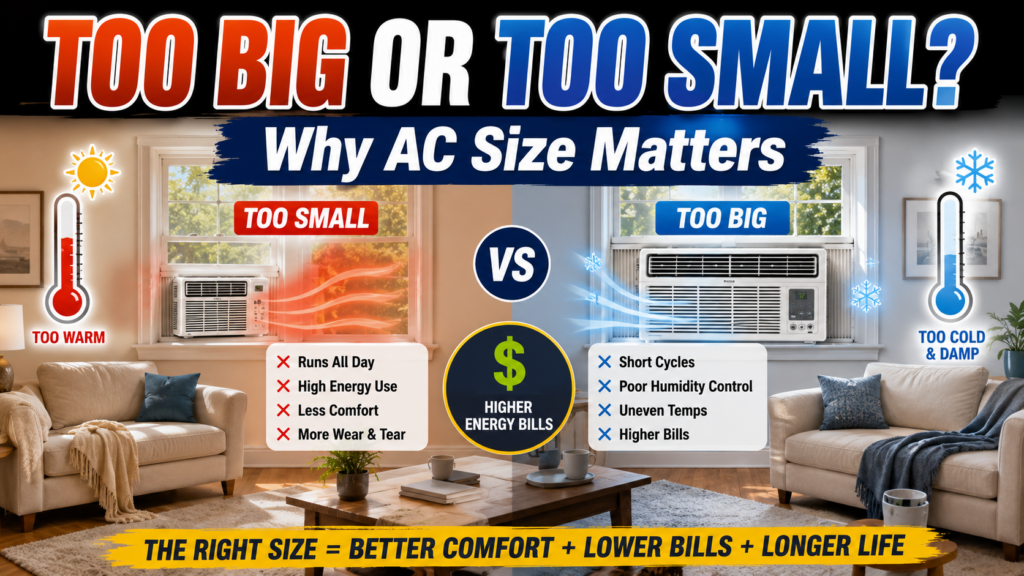
An air conditioner that is too small may run almost continuously during hot weather while struggling to reach the desired temperature. A unit that is too large can create an entirely different problem.
When an oversized air conditioner cools a room too quickly, it shuts off before removing enough moisture from the air. The room may feel cold, but it can still feel damp and uncomfortable.
Comfort depends on both temperature and humidity control.
This is why proper sizing matters far more than many homeowners expect.
The Question Most Buyers Ask Too Late
A surprising number of homeowners discover sizing mistakes only after their first electric bill arrives.
For example, a homeowner in Texas may install a large 14,000 BTU unit in a small bedroom thinking it will cool faster. The room becomes cold quickly, but the air still feels damp because the system shuts off before removing enough humidity.
On the other hand, someone in Arizona may choose a smaller unit to save money, only to find that it runs nearly all day during July and August.
The goal is not to buy the biggest air conditioner. The goal is to buy the right-sized one for your specific space.
A Quick BTU Starting Point
Room size still provides a useful starting point when comparing models.
| Room Size | Recommended BTU |
|---|---|
| Up to 150 sq ft | 5,000 BTU |
| 150–250 sq ft | 6,000 BTU |
| 250–350 sq ft | 8,000 BTU |
| 350–450 sq ft | 10,000 BTU |
| 450–550 sq ft | 12,000 BTU |
| 550–700 sq ft | 14,000 BTU |
These recommendations work well as a baseline, but they should never be treated as the final answer.
Two rooms with identical square footage can have completely different cooling requirements.
Why Similar Rooms Can Need Different AC Sizes
Imagine two rooms that are both 300 square feet.
One is a shaded basement family room in Ohio.
The other is an upstairs bedroom in Phoenix with large west-facing windows that receive direct afternoon sunlight.
Despite having the same dimensions, the Arizona bedroom will likely need noticeably more cooling power.
Several factors can increase cooling demand:
- Direct sunlight
- Poor insulation
- High ceilings
- Multiple occupants
- Large windows
- Heat-generating electronics
- Open floor plans
Room size is only one piece of the equation. The environment surrounding the room matters just as much.
The Hidden Cost of Buying Too Much Air Conditioner
Many homeowners never realize their air conditioner is oversized.
The room feels cool, so everything appears to be working correctly.
However, oversized units often create a problem called short cycling.
Short cycling occurs when the air conditioner repeatedly turns on and off throughout the day instead of operating in longer, more efficient cycles.
Over time this can lead to:
- Higher electricity usage
- Increased wear on components
- Poor humidity control
- Uneven room temperatures
- More maintenance issues
An oversized unit may seem powerful at first, but it can actually cost more to operate over the long term.
Window AC vs Portable AC: Understanding the Difference
Many shoppers compare BTU ratings without considering how the unit is designed.
A 10,000 BTU window air conditioner and a 10,000 BTU portable air conditioner often do not perform the same way in real-world conditions.
Window units place most of the heat-generating components outside the living space. Portable units keep those components indoors and rely on an exhaust hose to remove heat.
As a result, window air conditioners are typically more efficient.
A window unit often provides more cooling performance per dollar spent than a comparable portable model.
If installation restrictions allow it, window air conditioners usually offer better long-term value.
Why Portable Air Conditioners Often Disappoint Buyers
Portable air conditioners are popular because they do not require permanent installation.
Many renters choose them because window units may not be allowed in their building.
However, first-time buyers often underestimate how much cooling performance can be lost through the exhaust hose.
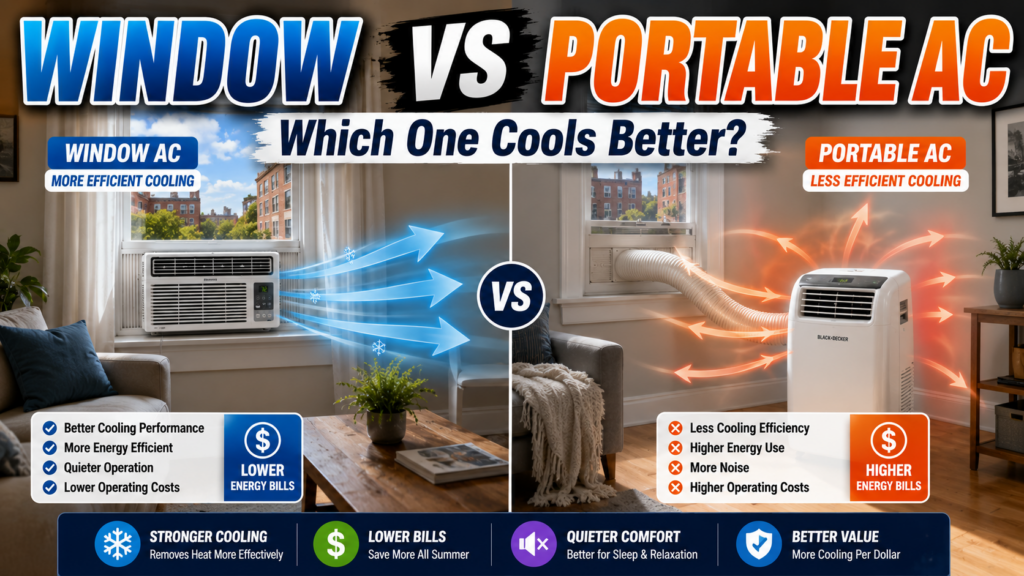
In a small apartment bedroom, a portable unit may perform reasonably well. In a large sunny living room, cooling performance may feel weaker than expected.
This is one reason many homeowners end up purchasing a larger portable air conditioner than they originally planned.
If your building allows window units, they generally deliver better cooling efficiency and lower operating costs.
Sometimes Humidity Is the Real Problem
Not every comfort problem requires a larger air conditioner.
In many southeastern states, humidity can be the primary issue.
A home may already be maintaining a temperature of 76°F, yet still feel sticky and uncomfortable.
Many homeowners mistakenly assume they need more cooling capacity when what they actually need is better moisture removal.
In these situations, adding a dehumidifier can sometimes improve comfort more effectively than upgrading to a larger air conditioner.
This is especially common in places such as Florida, Louisiana, and coastal regions of the Carolinas.
How Much Can the Wrong AC Size Cost You?
Many buyers focus entirely on the purchase price.
The long-term operating cost is often far more important.
A properly sized Energy Star certified window air conditioner may cost only a few dollars per week to operate during moderate summer weather.
An oversized or undersized unit can run inefficiently and consume more electricity throughout the cooling season.
Depending on local utility rates and usage habits, the difference can add up to hundreds of dollars over the life of the unit.
Buying the correct size once is usually cheaper than paying higher energy bills every summer.
Common AC Buying Mistakes Homeowners Make
One of the most common mistakes is measuring the entire apartment instead of the room being cooled.
Another mistake is ignoring ceiling height.
A room with 10-foot ceilings contains significantly more air volume than a room with standard 8-foot ceilings.
Home offices are another area where sizing mistakes occur.
Gaming computers, multiple monitors, printers, and networking equipment generate heat throughout the day. A home office may require more cooling than a guest bedroom of the same size.
Many buyers also fail to account for afternoon sunlight, which can dramatically increase cooling demand.
Repair or Replace an Older Air Conditioner?
If your current air conditioner is more than 10 to 15 years old, replacement may be worth considering.
Older units often consume more electricity and may struggle to maintain consistent temperatures during extreme weather.
For newer systems, repairs can still be cost-effective, especially when dealing with issues such as capacitors, thermostats, or fan motors.
However, repeated breakdowns combined with rising energy bills often indicate that replacement is the better long-term financial decision.
For most window air conditioners, replacement becomes more practical when compressor-related repairs are required.
Quick AC Sizing Checklist

Before buying an air conditioner, ask yourself these questions:
- How many square feet are you cooling?
- Does the room receive strong afternoon sunlight?
- Are the ceilings higher than 8 feet?
- Will more than two people regularly use the room?
- Is humidity a bigger issue than temperature?
- Are you considering a portable or window AC?
- Is the room well insulated?
- Will the unit run daily throughout the summer?
If you answered “yes” to several of these questions, a basic BTU chart may not provide an accurate recommendation.
Real-world conditions matter just as much as room size.
FAQ
What size air conditioner do I need for a 500-square-foot room?
Most homeowners will need approximately 12,000 BTU, although ceiling height, insulation quality, sunlight exposure, and occupancy levels can affect the recommendation.
Is it bad to buy an air conditioner that is too powerful?
Yes. Oversized units often short cycle, reduce humidity control effectiveness, and may increase long-term operating costs.
Are portable air conditioners less efficient than window units?
In many situations they are. Portable units typically lose some efficiency because they must exhaust heat through a hose while remaining inside the room.
Can a dehumidifier replace an air conditioner?
Not entirely. A dehumidifier removes moisture but does not significantly lower air temperature. However, in humid climates it can improve comfort when used alongside an appropriately sized AC.
Choosing the right air conditioner size is not simply about finding the highest BTU number available. A properly sized unit cools more evenly, controls humidity more effectively, uses less energy, and often lasts longer. Spending a few extra minutes evaluating your room before buying can prevent years of unnecessary expenses and comfort issues.
Related Reading:
• DIY AC Cleaning vs Professional AC Cleaning: Which Is Worth It?
• Why Does Your Air Conditioner Smell? Dirty Filter vs Mold Growth Explained