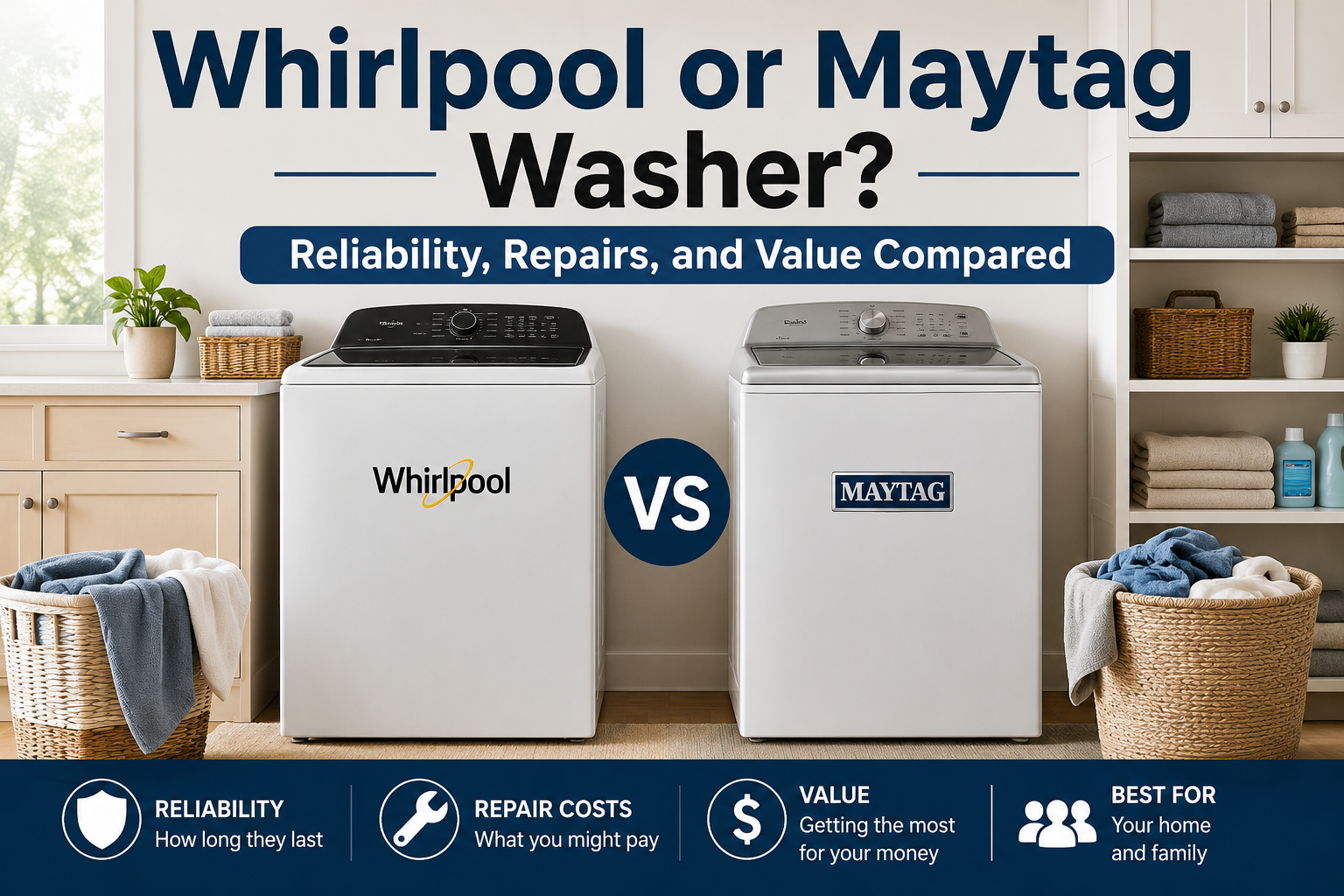
Whirlpool or Maytag Washer? Reliability, Repairs, and Value Compared
Shopping for a new washing machine often comes down to two familiar names: Whirlpool and Maytag. Since both brands share the same parent company, many buyers wonder whether they’re actually different—or simply the same washer with different logos.
The answer is more nuanced.
While Whirlpool and Maytag share certain engineering platforms and replacement parts, they target different types of homeowners. One emphasizes value and everyday practicality, while the other focuses more on heavy-duty performance and durability. Choosing the right one depends on your laundry habits, household size, and long-term expectations.
Quick Answer
If reliability is your top priority, both Whirlpool and Maytag perform well in the U.S. market because they share many internal components. Whirlpool generally offers better overall value and a wider model selection, while Maytag often appeals to households that wash large loads frequently and want stronger cleaning performance with a longer limited parts warranty on selected models.
| Feature | Whirlpool | Maytag |
|---|---|---|
| Overall Reliability | Excellent | Excellent |
| Typical Price | $$ | $$–$$$ |
| Cleaning Performance | Very Good | Excellent |
| Heavy-Duty Cycles | Good | Excellent |
| Energy Efficiency | Excellent | Very Good |
| Smart Features | Available on many models | Available on selected models |
| Repair Costs | Moderate | Moderate |
| Best For | Everyday households | Large families and heavy laundry users |
| Warranty | Standard limited warranty | Some models include longer limited parts coverage |
They Share DNA—but Not the Same Buying Experience
Many shoppers are surprised to learn that Whirlpool Corporation owns both Whirlpool and Maytag. That means you’ll often find similar motors, pumps, control systems, and replacement parts across comparable models.
However, the overall ownership experience can still feel different.
Whirlpool usually builds washers aimed at broad household needs. Buyers can choose from budget-friendly machines, mid-range smart models, or larger premium units without spending significantly more.
Maytag tends to position itself toward durability and stronger stain removal. Marketing often emphasizes powerful wash cycles and machines designed for heavier weekly laundry demands.
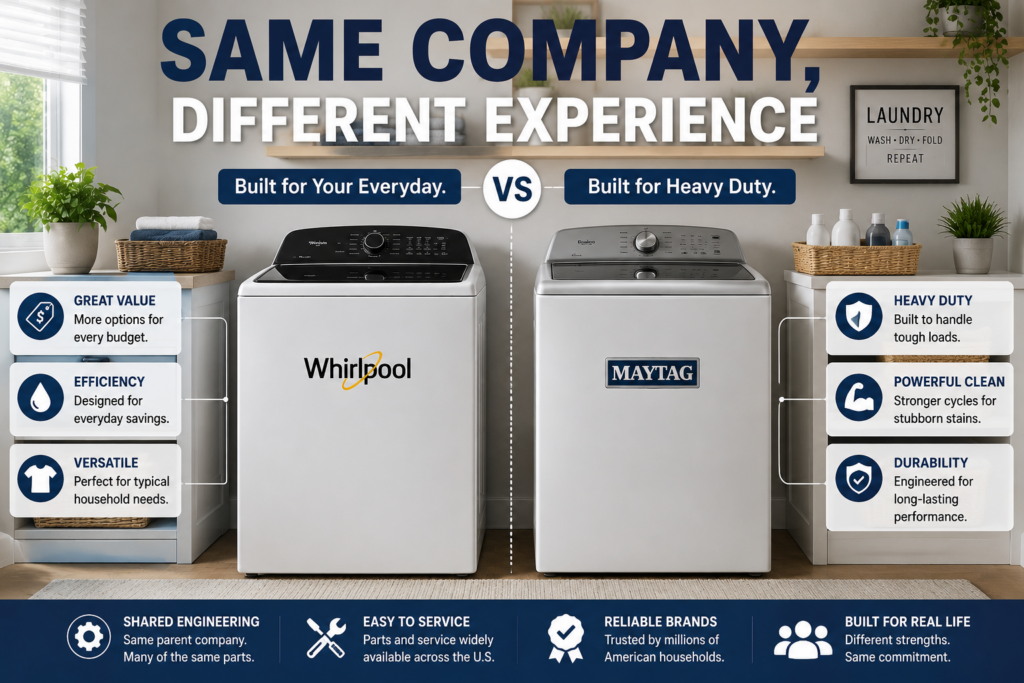
Alt Text: Whirlpool and Maytag front-load washing machines displayed side by side in a modern American laundry room.
For a family of four that runs multiple loads every week, the differences become more noticeable. Extra-heavy bedding, sports uniforms, and towels may benefit from Maytag’s stronger heavy-duty cycles, while smaller households may appreciate Whirlpool’s broader selection and pricing flexibility.
Comparing Reliability Beyond Marketing Claims
Reliability isn’t simply about how long a washer lasts.
It also includes:
- Frequency of repairs
- Availability of replacement parts
- Cost of service
- Ease of maintenance
- Manufacturer support
Both Whirlpool and Maytag generally score well because replacement parts are widely available throughout the United States. Independent repair technicians are also familiar with both brands, which can reduce repair delays compared with less common manufacturers.
Proper maintenance still plays the biggest role in longevity.
Simple habits such as avoiding overloading, cleaning the drain filter when applicable, leaving the door open after front-load cycles, and using the correct detergent can add years to almost any washing machine.
Rather than asking which brand never breaks, it’s more realistic to compare how easily each one can be maintained when normal wear eventually occurs.
Cleaning Performance in Everyday Homes
Cleaning ability depends more on the individual model than the brand name alone, but each company has developed a slightly different reputation.
Whirlpool washers typically focus on balanced performance. Most models clean everyday clothing efficiently while keeping water and energy usage relatively low.
Maytag washers often use more aggressive wash actions on heavy-duty settings. These cycles can be especially useful for work clothes, muddy sports uniforms, or larger comforters.

Alt Text: Close-up comparison of Whirlpool and Maytag washer control panels showing different wash cycle options.
For apartment living or couples with lighter laundry needs, the extra cleaning power may not justify paying more.
On the other hand, homeowners regularly washing bulky blankets or heavily soiled clothing may appreciate the additional performance offered by certain Maytag models.
Neither brand should be judged solely by one cycle. Looking at capacity, spin speed, cycle options, and water extraction often provides a better picture of real-world performance.
Repair Costs and Long-Term Ownership
No appliance lasts forever.
Fortunately, both Whirlpool and Maytag remain among the easier brands to repair in the United States because parts are commonly stocked by service companies.
Typical repair costs may include:
| Common Repair | Estimated Cost |
|---|---|
| Drain pump replacement | $180–$350 |
| Door lock replacement | $150–$300 |
| Water inlet valve | $170–$320 |
| Control board replacement | $300–$600 |
| Drive belt or pulley | $180–$400 |
Actual costs vary depending on your location, labor rates, warranty status, and model year.
One advantage of buying either brand is that repair technicians generally have extensive experience servicing them, reducing the chances of long waits for specialized parts or unfamiliar diagnostics.
If long-term repairability matters, both brands remain strong choices compared with manufacturers that have more limited service networks.
Features That Matter More Than the Brand Name
Many buyers spend too much time comparing logos instead of comparing features.
Consider these factors first:
- Load capacity
- Spin speed
- Noise level
- Steam cleaning options
- Smart connectivity
- Cycle customization
- Energy efficiency
- Available warranty coverage
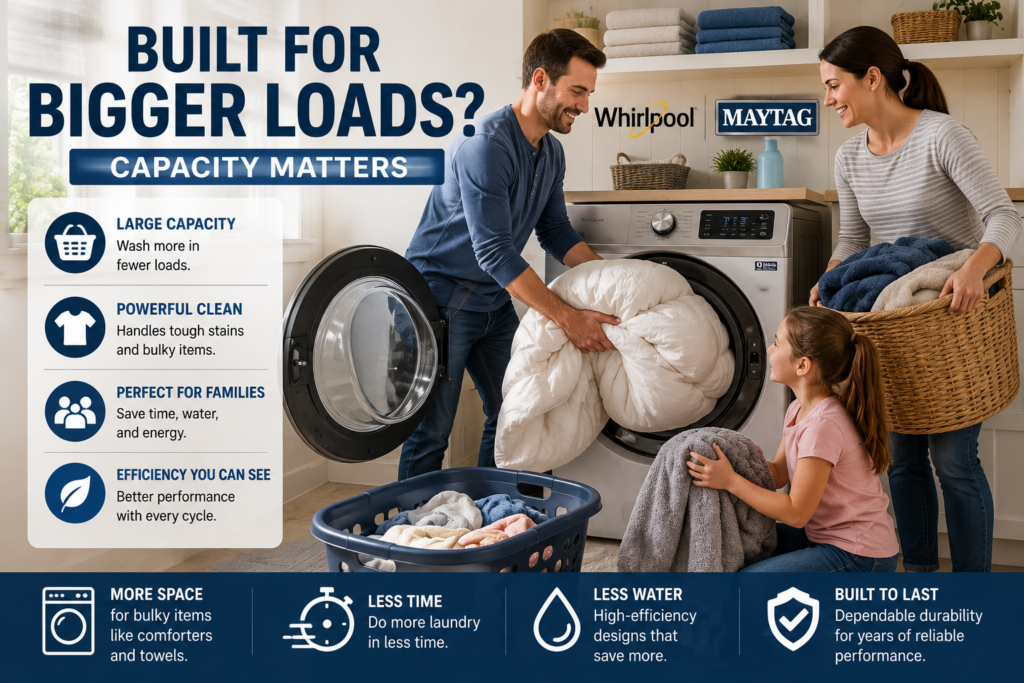
Alt Text: Large family loading towels and bedding into a high-capacity washing machine.
A first-time homeowner may benefit more from an affordable Whirlpool model with excellent efficiency, while someone replacing an aging washer after fifteen years might decide the heavier-duty options available from Maytag better fit future needs.
Even within the same brand, a higher-tier model can provide noticeably different performance than an entry-level machine.
Typical Price Comparison
Whirlpool generally offers one of the broadest pricing ranges available.
Approximate U.S. retail pricing:
- Whirlpool top-load washers: $550–$950
- Whirlpool front-load washers: $800–$1,300
- Maytag top-load washers: $650–$1,050
- Maytag front-load washers: $850–$1,500
Holiday promotions during Memorial Day, Labor Day, Black Friday, and year-end sales often reduce prices by several hundred dollars.
Buying based solely on the lowest price may not deliver the best value if a larger capacity or longer warranty better matches your household’s needs.
Winner by Category
| Category | Winner |
|---|---|
| Overall Value | Whirlpool |
| Heavy-Duty Cleaning | Maytag |
| Budget Options | Whirlpool |
| Large Families | Maytag |
| Model Variety | Whirlpool |
| Repair Network | Tie |
| Parts Availability | Tie |
| Long-Term Reliability | Tie |
Who Should Buy Each Brand?
Choose Whirlpool if you:
- Want more model choices.
- Prefer strong value for the price.
- Need an efficient everyday washer.
- Have a moderate laundry workload.
Choose Maytag if you:
- Wash large loads several times each week.
- Frequently clean heavily soiled clothing.
- Prefer stronger heavy-duty wash cycles.
- Value enhanced durability features available on certain models.
Overall Recommendation
Neither Whirlpool nor Maytag is objectively the better washer for every buyer.
Whirlpool stands out for flexibility, affordability, and broad model availability, making it an excellent fit for most American households.
Maytag earns its reputation by focusing on tougher cleaning performance and durable construction aimed at families with demanding laundry routines.
Instead of choosing based on brand loyalty alone, compare the specific models you’re considering. Capacity, warranty, cycle options, efficiency, and local pricing often have a greater impact on satisfaction than the badge on the front of the machine.
Comparison Summary
If your goal is the best balance between price and reliability, Whirlpool remains an easy recommendation for many homeowners.
If your household routinely handles oversized loads, work clothes, pet bedding, or frequent laundry days, Maytag may provide enough additional performance to justify the higher purchase price.
Both brands have solid reputations, extensive repair support across the United States, and the potential to provide well over a decade of dependable service when properly maintained.
FAQ
Is Maytag more reliable than Whirlpool?
Not necessarily. Since both brands share many engineering components, overall reliability is generally very similar. Differences usually come down to the individual model and how well it is maintained.
Which washer lasts longer?
Either brand can often last 10–15 years or more with proper care. Avoiding overloads, cleaning the machine regularly, and addressing small issues early can significantly extend its lifespan.
Are Maytag washers worth the extra cost?
They can be if you frequently wash heavy loads or need stronger cleaning performance. For lighter household use, Whirlpool often provides comparable reliability at a lower price.
Do Whirlpool and Maytag use the same replacement parts?
Many comparable models share components because both brands belong to Whirlpool Corporation, although exact parts vary by model.
Buying Checklist
- Compare capacity before comparing brand names.
- Check the warranty details for your specific model.
- Consider how many loads your household runs each week.
- Look beyond sale prices and compare long-term operating costs.
- Measure your laundry space before ordering.
- Verify local repair service availability.
- Read owner reviews for the exact model you’re considering.
- Choose features you’ll actually use rather than paying extra for unnecessary technology.