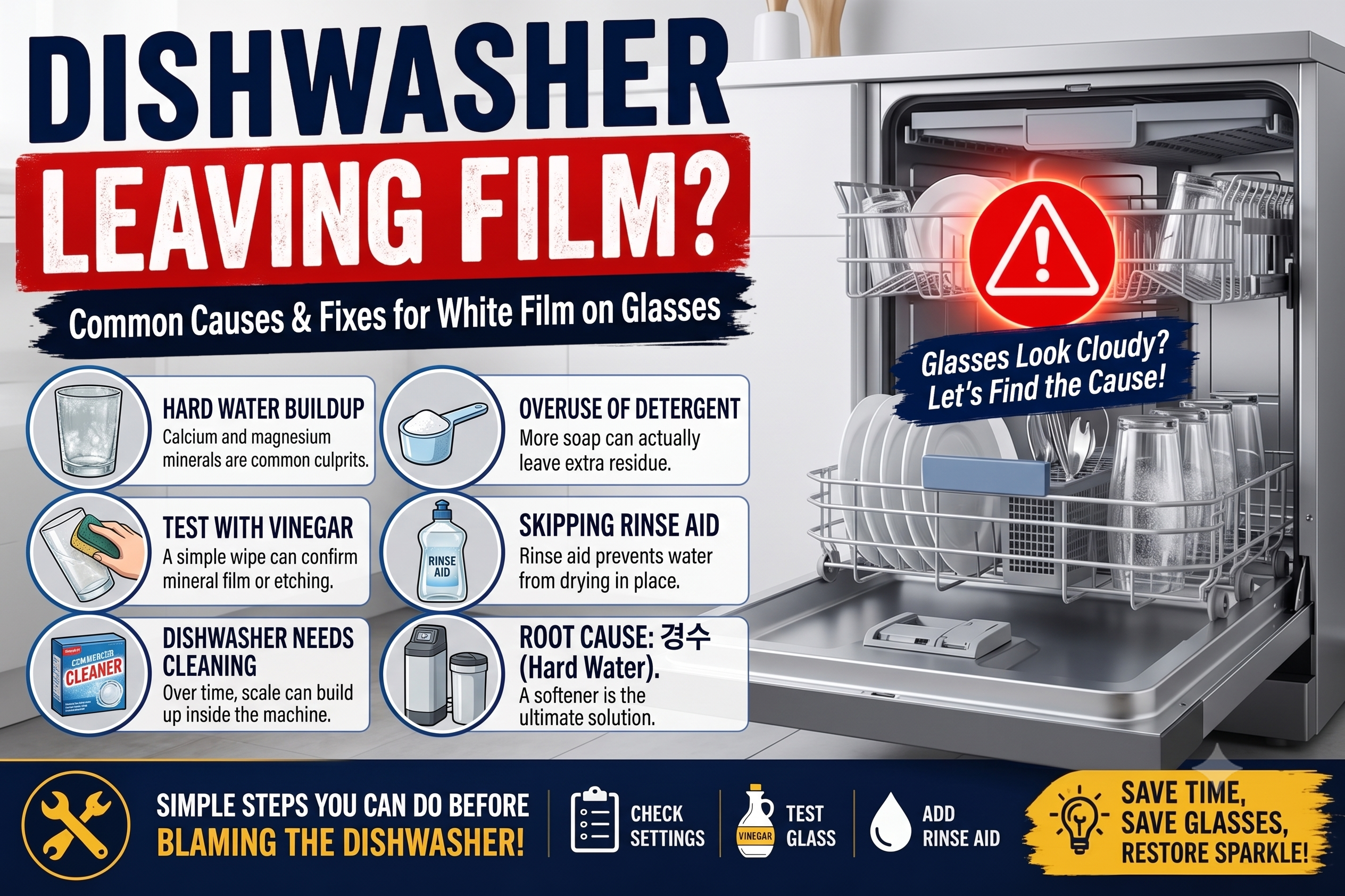
Why Does My Dishwasher Leave a White Film on Glasses? How to Fix Hard Water Stains for Good
You unload the dishwasher, grab a clean glass, hold it up to the light—and immediately notice something doesn’t look right.
Instead of sparkling clean glassware, there’s a cloudy white film covering the surface.
At first, most people blame the dishwasher.
Then they blame the detergent.
Some even start shopping for a new appliance.
But in many cases, the dishwasher isn’t the problem at all.
The real culprit is often hard water.
If you’ve been dealing with cloudy glasses, chalky residue, or white spots that seem impossible to remove, you’re not alone. It’s one of the most common dishwasher complaints among homeowners across the United States, especially in areas with naturally hard water.
The good news?
Most hard water stains can be fixed without replacing your dishwasher.
Before You Blame the Dishwasher
A lot of homeowners assume a white film means their dishwasher isn’t cleaning properly.
That’s understandable.
After all, dishes are supposed to come out cleaner than when they went in.
But the white residue you see is usually left behind after the washing process is finished.
When water contains high levels of minerals such as calcium and magnesium, those minerals stay on the surface of dishes after the water evaporates.
Over time, the buildup becomes more noticeable.
That’s why glasses often look cloudy even though they were technically cleaned.
The dishwasher washed away the food.
It just couldn’t prevent the minerals from staying behind.
Why Glasses Usually Show the Problem First
You might notice the issue most often on drinking glasses, wine glasses, or clear glass bowls.
There’s a simple reason for that.
Glass reflects light.
Even a small amount of mineral buildup becomes obvious when light hits the surface.
White plates may have the same residue, but it’s harder to see.
A clear drinking glass exposes every spot, streak, and mineral deposit.
That’s why many homeowners first discover a hard water problem when their favorite glassware starts looking permanently dirty.
The Vinegar Test Every Homeowner Should Try
Before spending money on repairs or replacement parts, there’s a quick test worth trying.
Take one of the cloudy glasses and apply a small amount of white vinegar to the affected area.
Wait a few seconds and wipe it clean.
If the cloudiness disappears, hard water minerals are likely the cause.
If the cloudy appearance remains, the glass may have become etched.
This distinction matters.
Mineral deposits sit on the surface and can often be removed.
Etching is permanent damage to the glass itself.
Once etching occurs, no cleaner or dishwasher treatment will fully restore the original appearance.
That’s why it’s important to address hard water issues before they become a long-term problem.
Hard Water Is More Common Than Most People Realize
Many Americans don’t know whether they have hard water until appliances start showing signs of mineral buildup.
If you’ve noticed white residue on shower doors, faucets, coffee makers, or kettle interiors, hard water is already affecting your home.
It’s particularly common in parts of:
- Texas
- Arizona
- Nevada
- Utah
- Colorado
- California
- Midwest states
Even homeowners with brand-new appliances can experience hard water problems if the local water supply contains high mineral levels.
In other words, replacing the dishwasher won’t necessarily solve the issue.
The Most Overlooked Dishwasher Feature
Ask an appliance technician about cloudy glasses, and one of the first questions they’ll often ask is surprisingly simple.
“Are you using rinse aid?”
Many households skip it.
Some people don’t even know what it does.
Rinse aid helps water slide off dishes more effectively during the drying process.
Without it, water droplets remain on surfaces longer.
As those droplets evaporate, minerals stay behind.
That’s exactly how white spots and cloudy film develop.
For many homeowners, simply keeping the rinse aid dispenser filled can noticeably improve glass clarity within a few wash cycles.
It’s one of the cheapest fixes available.
More Detergent Isn’t Always Better
When dishes don’t look clean, the natural reaction is often to use more detergent.
Unfortunately, that can make the problem worse.
Modern dishwasher detergents are highly concentrated.
Adding extra detergent doesn’t necessarily improve cleaning performance.
Instead, it can leave additional residue behind, especially when combined with hard water.
If you’ve recently switched detergents or started using larger amounts, try scaling back slightly.
Many households are surprised to discover that less detergent actually produces better results.
The goal isn’t more soap.
The goal is proper rinsing.
Your Dishwasher May Need Cleaning Too
This sounds strange at first.
After all, isn’t a dishwasher constantly cleaning itself?
Not exactly.
Over months and years of use, mineral deposits can build up inside the appliance.
Spray arms, filters, heating elements, and interior surfaces can all collect scale from hard water.
As that buildup grows, cleaning performance can gradually decline.
Running a dishwasher cleaner once a month can help remove accumulated minerals and improve overall performance.
Some homeowners use white vinegar during an empty cycle, while others prefer commercial dishwasher cleaning products.
Either approach can help reduce mineral accumulation.
Think of it as routine maintenance rather than a repair.
When a Water Softener Starts Making Sense
If hard water is affecting more than just your dishwasher, it may be time to look at the bigger picture.
A whole-house water softener removes calcium and magnesium before water reaches your appliances.
That means fewer deposits on:
- Glassware
- Faucets
- Shower doors
- Water heaters
- Washing machines
- Dishwashers
For households dealing with persistent hard water issues, a water softener often solves multiple problems at once.
It’s a larger investment upfront, but many homeowners find the long-term benefits extend far beyond cleaner dishes.
The Mistake That Ruins Glassware
One of the biggest mistakes people make is assuming cloudy glasses are harmless.
At first, they usually are.
Mineral deposits can often be removed.
The problem starts when the buildup continues month after month.
Over time, minerals and detergents can slowly damage the surface of glassware.
Eventually, the cloudiness becomes permanent.
Once glass etching occurs, replacement is usually the only solution.
That’s why it’s better to address the issue early rather than waiting until expensive wine glasses or everyday drinking glasses become permanently dull.
So What’s the Best Fix?
For most households, the solution isn’t buying a new dishwasher.
Start with the basics.
Check the rinse aid dispenser.
Reduce excessive detergent use.
Clean the dishwasher thoroughly.
Test for hard water using vinegar.
If mineral buildup continues throughout the house, consider whether a water softener makes sense for your area.
In many cases, these simple steps solve the problem completely.
The next time you open the dishwasher, your glasses should actually look clean—not cloudy.
And that’s usually a sign that the dishwasher was never the problem in the first place.
Related Reading:
• Why Is My Washer Shaking Violently During Spin Cycle? 7 Common Causes and Fixes
• LG WashTower vs Samsung Bespoke AI: Which Laundry System Is Better in 2026?