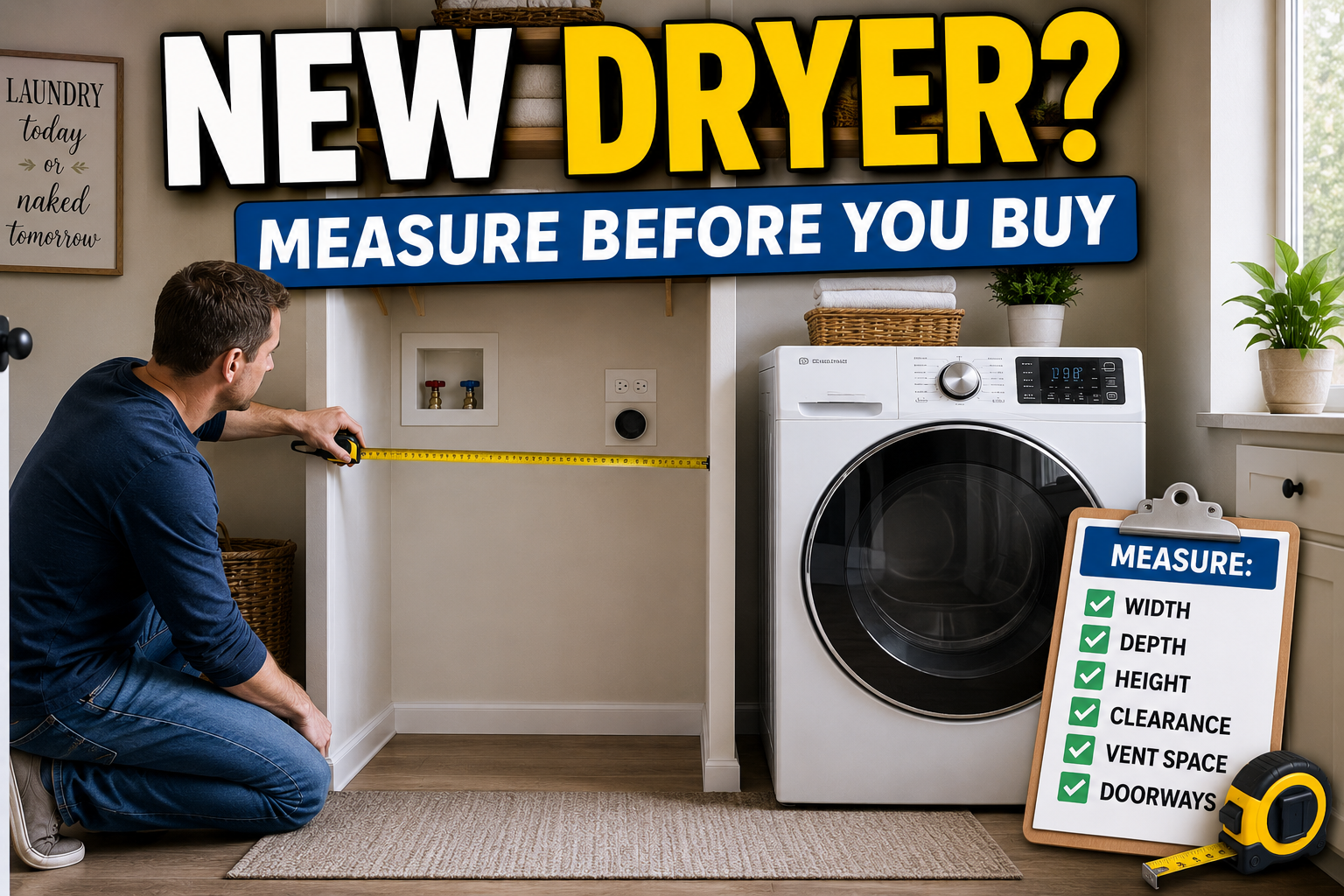
Buying a new dryer seems simple until delivery day arrives and the appliance won’t fit through the hallway, doesn’t have enough room for the vent hose, or blocks the laundry room door from opening.
A few careful measurements before shopping can prevent frustrating surprises, installation delays, and unnecessary delivery fees.
Whether you’re replacing an electric dryer, switching to a gas model, or upgrading to a larger capacity unit, measuring the entire installation area—not just the old dryer—is the smartest first step.
Quick Answer
To measure for a new dryer, record the available width, depth, and height of your laundry space, then compare those dimensions with the manufacturer’s installation requirements. Also measure doorways, hallways, vent locations, gas or electrical connections, and leave enough clearance behind and around the dryer for safe airflow and maintenance.
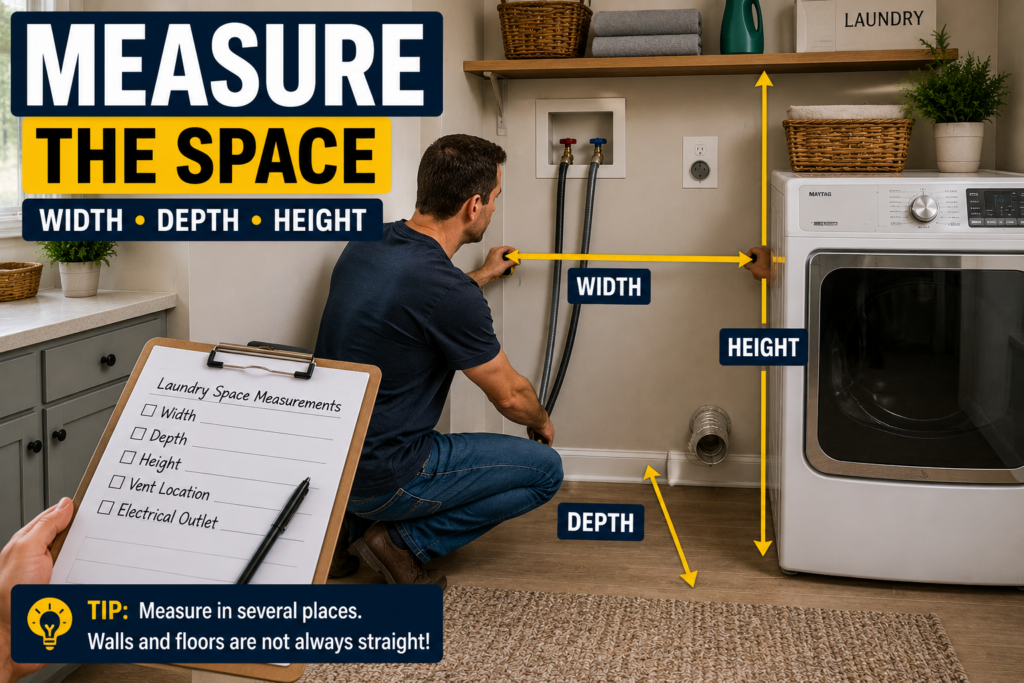
Alt Text: Homeowner measuring a laundry room before purchasing a new clothes dryer.
Measure the Installation Space First
Start where the dryer will actually sit.
Using a tape measure, record:
- Width
- Depth
- Height
Measure each dimension in multiple locations because walls, flooring, and cabinetry aren’t always perfectly square.
Don’t rely on measuring your existing dryer alone.
Modern dryers often have larger drums, different control panel designs, or deeper cabinets that require additional installation space.
If overhead cabinets are installed above the dryer, make sure there is enough clearance to access controls comfortably.
Always compare your measurements with the manufacturer’s recommended installation dimensions instead of only the listed appliance size.
Dryers Need More Clearance Than Many People Expect
Unlike washing machines, dryers generate heat and require proper airflow to operate efficiently.
Leaving too little space behind the dryer can compress the vent duct, reduce airflow, increase drying times, and even create a potential fire hazard.
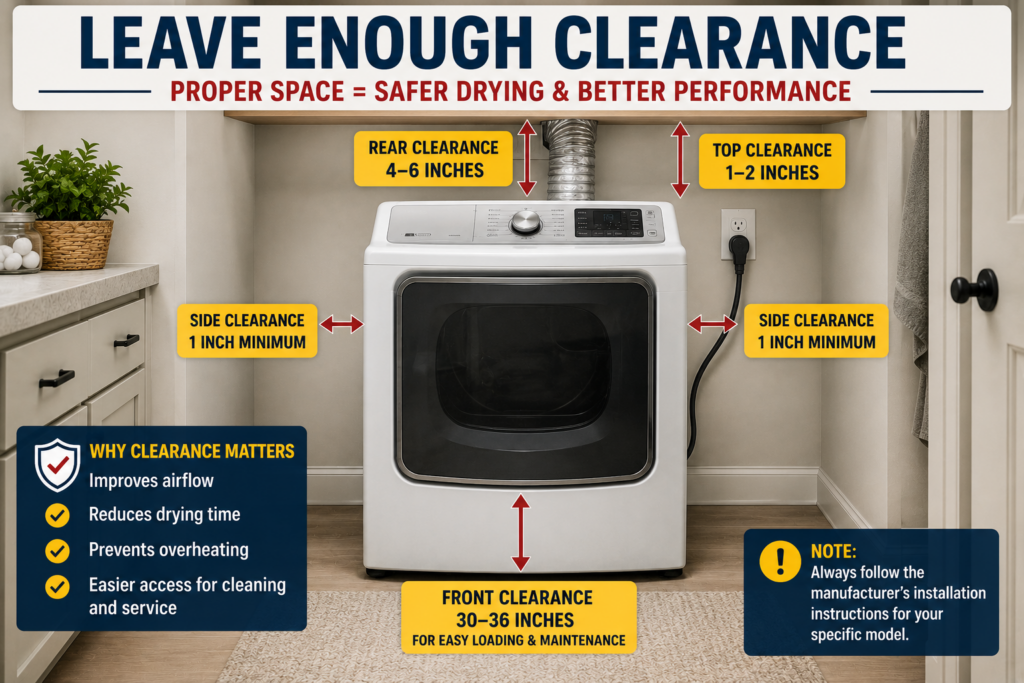
Alt Text: Diagram showing recommended dryer installation clearances and vent space.
Although exact recommendations vary by manufacturer, many installers suggest approximately:
| Location | Typical Clearance |
|---|---|
| Rear | 4–6 inches |
| Each side | 1 inch minimum |
| Top | 1–2 inches |
| Front working space | 30–36 inches |
Gas dryers may require additional consideration around the gas supply connection depending on the installation layout.
Never push the dryer tightly against the wall simply to gain extra floor space.
Measure the Entire Delivery Route
One of the most common installation problems has nothing to do with the laundry room itself.
The dryer still has to reach it.
Before ordering, measure:
- Front entrance
- Interior doors
- Hallways
- Stairways
- Tight corners
- Utility room entrances
- Elevator dimensions if you live in an apartment or condominium
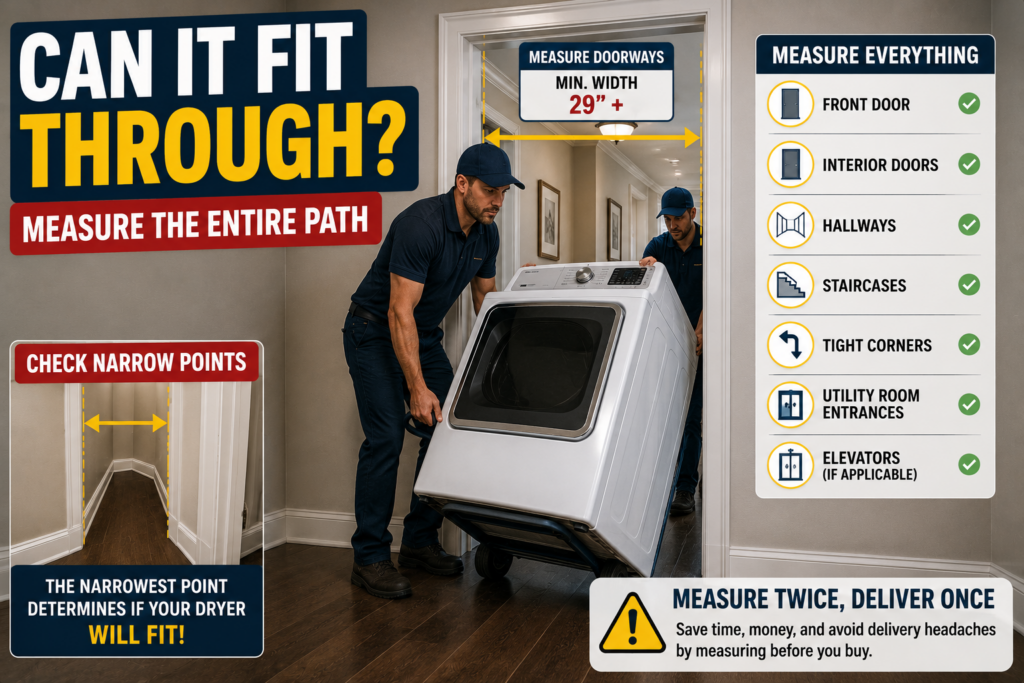
Alt Text: Appliance delivery team moving a dryer through a narrow hallway inside a home.
The narrowest point along the delivery path determines whether the appliance can be installed without removing doors or trim.
For example, a budget-conscious buyer replacing an older compact dryer may discover that today’s larger-capacity model fits perfectly inside the laundry room but cannot make the final turn into the basement.
Checking the route in advance helps avoid unexpected delivery charges or rescheduling.
Don’t Overlook the Dryer Vent
The dryer vent is just as important as the available floor space.
Before purchasing a replacement dryer, inspect:
- Vent outlet location
- Vent diameter
- Existing duct condition
- Distance to the exterior wall
Long vent runs or multiple sharp bends reduce drying efficiency.
If you’re remodeling the laundry room, this is an excellent opportunity to shorten or improve the vent layout.
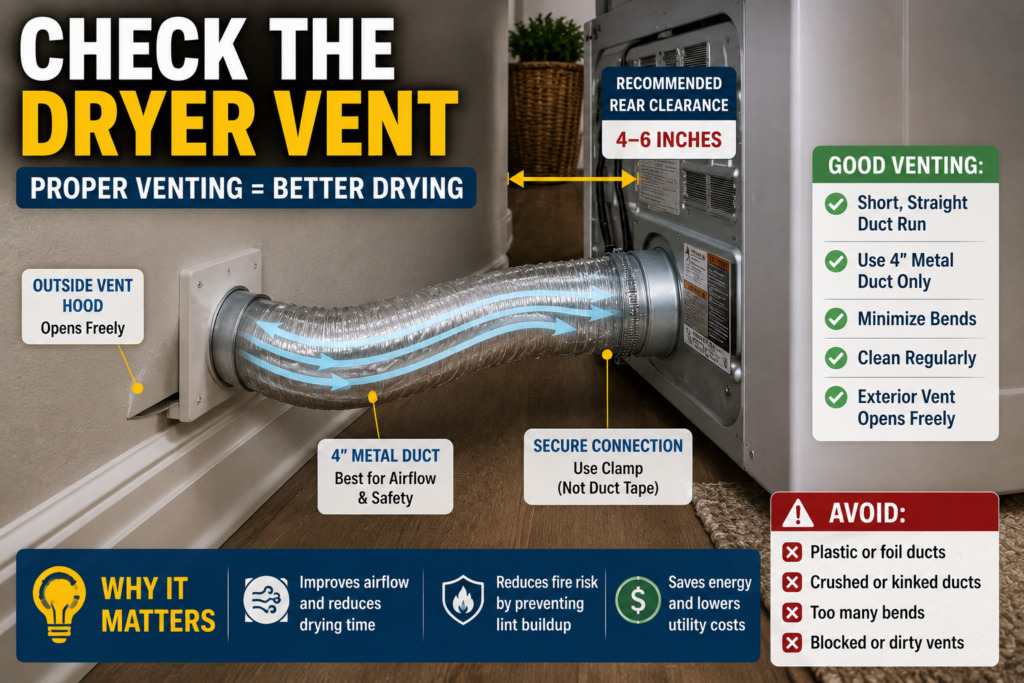
Alt Text: Dryer vent connection behind a clothes dryer with proper installation clearance.
Whenever possible, use rigid or semi-rigid metal ducting instead of flexible plastic or foil ducts, which can trap lint more easily.
A properly installed vent improves drying performance while reducing energy consumption.
Electric vs. Gas Dryer Measurements
Physically, electric and gas dryers are often very similar in size.
The installation requirements, however, are different.
Electric dryers require the correct 240-volt electrical outlet within reach of the factory power cord.
Gas dryers require:
- Gas shutoff valve
- Flexible gas connector
- Proper electrical outlet
- Approved vent system
Before purchasing, verify that utility connections line up with the new appliance specifications.
Changing from electric to gas—or vice versa—may require professional installation and additional utility work.
Planning for Stacked or Pedestal Installations
If you’re installing a stacked washer and dryer or adding storage pedestals, calculate the finished height before ordering.
Stacked laundry systems often require:
- Higher ceiling clearance
- Additional installation space
- Manufacturer-approved stacking kit
- Comfortable access to dryer controls
Likewise, adding a pedestal can raise the dryer significantly.
If shorter household members will use the appliance regularly, think about everyday accessibility as well as available space.
Common Dryer Measuring Mistakes
Many installation issues can be avoided by watching for these common oversights:
- Measuring only the existing appliance.
- Ignoring the vent hose behind the dryer.
- Forgetting door swing clearance.
- Not measuring hallways and corners.
- Assuming all dryers have identical dimensions.
- Forgetting gas or electrical connection locations.
- Overlooking stacked installation height.
Taking fifteen minutes with a tape measure is far easier than dealing with delivery problems after your new dryer arrives.
Final Thoughts
Choosing the right dryer begins long before comparing brands or features.
Accurate measurements help ensure the appliance fits comfortably, vents properly, operates efficiently, and remains easy to service throughout its lifespan.
By measuring the installation area, delivery route, utility connections, and ventilation space before you buy, you’ll avoid the most common installation problems and enjoy a much smoother replacement process.
FAQ
How much clearance does a dryer need?
Most dryers perform best with approximately 4–6 inches behind the unit for the vent connection, at least 1 inch on each side, and enough front clearance to load laundry and perform maintenance. Always follow the manufacturer’s installation guide.
Should I measure the old dryer?
No. Measure the available installation space instead. Modern dryers often differ in depth, height, and vent placement compared with older models.
Does a gas dryer require more installation space?
Not necessarily, but it does require safe access to the gas shutoff valve, flexible gas connector, and proper ventilation, which may influence installation clearance.
Can I reuse my existing dryer vent?
Often yes, provided it is the correct size, in good condition, and complies with current installation recommendations. If the duct is damaged, excessively long, or made from unsuitable materials, replacing it is usually the better option.
Checklist
- Measure the width, depth, and height of the installation space.
- Compare your measurements with the manufacturer’s installation specifications.
- Leave adequate clearance behind the dryer for the vent connection.
- Measure every doorway, hallway, staircase, and tight corner on the delivery path.
- Verify electrical or gas utility locations before ordering.
- Inspect the dryer vent for size, condition, and routing.
- Confirm stacked or pedestal installations will fit your ceiling height.
- Double-check every measurement before completing your purchase.
Related Reading:
• How to Measure for a New Washing Machine: A Complete Step-by-Step Guide
• Whirlpool or Maytag Washer? Reliability, Repairs, and Value Compared
• LG vs Samsung Washing Machines: Best Choice for Big Families
• LG vs Maytag Dryers: Reliability, Repair Costs, and Everyday Use