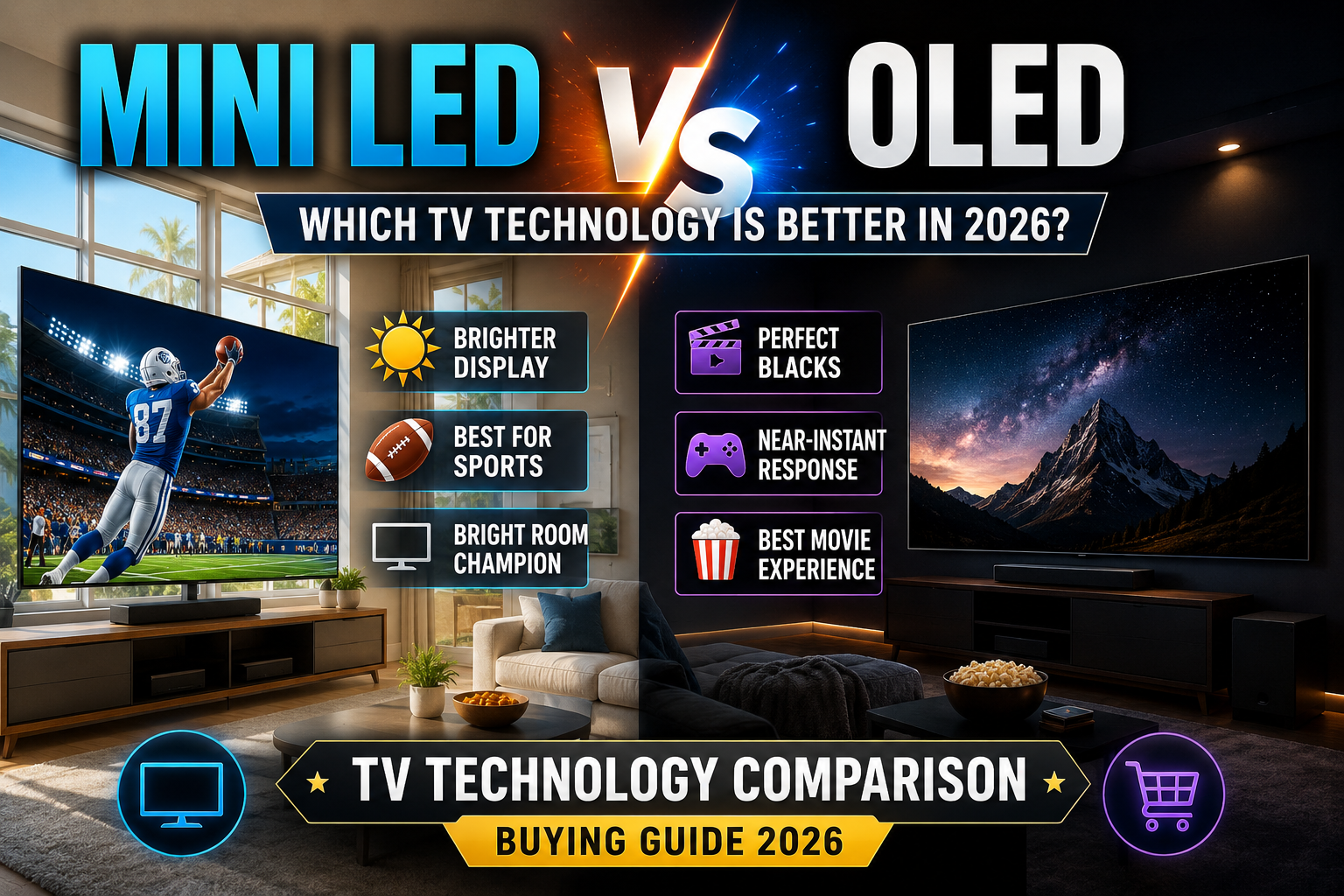
Mini LED vs OLED: Which TV Technology Is Better in 2026?
Shopping for a premium TV in 2026 means choosing between two of the most popular display technologies available today: Mini LED and OLED.
Both deliver exceptional picture quality, advanced gaming features, and impressive HDR performance. However, they excel in different viewing environments and use cases.
OLED TVs are known for perfect black levels and cinematic image quality, while Mini LED TVs offer outstanding brightness, strong value, and excellent performance in bright rooms.
So which technology is actually better?
The answer depends on your room, viewing habits, and budget.
Let’s break down the real-world differences.
Quick Summary
Choose OLED If:
✅ You primarily watch movies and streaming content
✅ You often watch TV in a dark room
✅ You want the best possible contrast
✅ Picture quality is your top priority
Choose Mini LED If:
✅ Your living room gets lots of sunlight
✅ You watch sports regularly
✅ You want a larger screen for your budget
✅ Long-term durability is a priority
What Is OLED?
OLED (Organic Light-Emitting Diode) is a self-emissive display technology. Every pixel produces its own light, meaning individual pixels can turn completely off when displaying black.
This creates perfect black levels and nearly infinite contrast.
Popular OLED TVs include LG OLED evo models, Samsung OLED TVs, and Sony BRAVIA OLED TVs.
The result is a picture that many movie enthusiasts consider the gold standard for home entertainment.
What Is Mini LED?
Mini LED is an advanced form of LED-backlit television technology.
Instead of using hundreds of LEDs behind the panel, Mini LED TVs use thousands of tiny LEDs arranged into local dimming zones.
This allows for significantly improved contrast, better HDR performance, and extremely high brightness levels.
Popular Mini LED TVs include Samsung Neo QLED models, Sony BRAVIA Mini LED TVs, TCL QM8 Series, and Hisense U8 Series.
Mini LED has become especially popular among buyers looking for large-screen TVs without paying OLED prices.
Picture Quality Comparison
Black Levels
This category still belongs to OLED.
Because each pixel can switch off completely, OLED TVs deliver true black instead of dark gray.
Movies with nighttime scenes, sci-fi content, and HDR films benefit greatly from this advantage.
🏆 Winner: OLED
Brightness
Mini LED technology dominates when it comes to peak brightness.
If your living room has large windows or significant daytime viewing, Mini LED often provides a more impactful picture.
🏆 Winner: Mini LED
Color Accuracy
Both technologies offer excellent color reproduction.
Most viewers will struggle to notice major differences during everyday viewing.
🏆 Tie
Viewing Angles
OLED TVs maintain image quality even when viewed from the side.
Mini LED TVs can lose some contrast and color consistency at wider angles.
🏆 Winner: OLED
Gaming Performance
Modern OLED and Mini LED TVs support premium gaming features such as:
- HDMI 2.1
- 120Hz refresh rates
- Variable Refresh Rate (VRR)
- Auto Low Latency Mode (ALLM)
OLED TVs offer near-instant response times, making motion appear exceptionally smooth during gaming.
Mini LED TVs, on the other hand, provide higher brightness levels that can be beneficial in bright rooms.
For PlayStation 5 and Xbox Series X users, both technologies provide excellent experiences.
🏆 Slight Edge: OLED
Burn-In: Is It Still a Problem?
Burn-in remains one of the most discussed topics when comparing OLED and Mini LED TVs.
The good news is that modern OLED TVs include advanced protection systems that dramatically reduce burn-in risk.
For most households, burn-in is no longer a major concern.
However, users who watch the same news channel all day or display static content for many hours every day may still prefer Mini LED technology.
🏆 Winner: Mini LED
Which Technology Is Better for Movies?
If your goal is to recreate a home theater experience, OLED remains the favorite among enthusiasts.
Perfect black levels, incredible contrast, and cinematic image quality make movies look spectacular.
🏆 Winner: OLED
Which Technology Is Better for Sports?
Sports fans often prefer Mini LED.
The additional brightness helps live events look vibrant even in brightly lit living rooms.
Football, basketball, baseball, and soccer broadcasts can benefit from the higher brightness output.
🏆 Winner: Mini LED
Mini LED vs OLED Comparison Table
| Category | OLED | Mini LED |
|---|---|---|
| Black Levels | ⭐⭐⭐⭐⭐ | ⭐⭐⭐⭐ |
| Brightness | ⭐⭐⭐⭐ | ⭐⭐⭐⭐⭐ |
| Movie Performance | ⭐⭐⭐⭐⭐ | ⭐⭐⭐⭐ |
| Sports Viewing | ⭐⭐⭐⭐ | ⭐⭐⭐⭐⭐ |
| Gaming | ⭐⭐⭐⭐⭐ | ⭐⭐⭐⭐ |
| Viewing Angles | ⭐⭐⭐⭐⭐ | ⭐⭐⭐⭐ |
| Burn-In Resistance | ⭐⭐⭐⭐ | ⭐⭐⭐⭐⭐ |
| Value | ⭐⭐⭐⭐ | ⭐⭐⭐⭐⭐ |
Which TV Should You Buy?
Buy OLED If:
- Movies are your primary focus
- You watch TV mostly at night
- You want the best overall picture quality
- You’re building a dedicated home theater
Buy Mini LED If:
- Your room is bright during the day
- You watch sports frequently
- You want a larger TV for the money
- Long-term durability is important
Final Verdict
Mini LED and OLED are both outstanding TV technologies in 2026.
🏆 Best Black Levels → OLED
🏆 Best Brightness → Mini LED
🏆 Best Movie Experience → OLED
🏆 Best Sports Viewing → Mini LED
🏆 Best Gaming Performance → OLED
🏆 Best Large-Screen Value → Mini LED
Best TV for Bright Rooms?
If your living room receives significant natural sunlight, Mini LED is often the better choice thanks to its superior brightness and glare resistance.
Best TV for Movies?
If cinematic picture quality is your priority, OLED continues to be the preferred option for many home theater enthusiasts due to its perfect black levels and outstanding contrast.
If you’re a movie lover who wants the most cinematic picture possible, OLED remains the benchmark.
If your living room is bright, you watch lots of sports, or you’re shopping for a larger screen on a budget, Mini LED is often the smarter choice.
Ultimately, the best TV isn’t the one with the most features—it’s the one that fits your room, viewing habits, and budget.
Related Reading:
- Samsung TV vs Sony TV: Which Brand Is Better in 2026?
- Samsung TV vs LG TV: Which Brand Is Better in 2026?
- 65 vs 75 Inch TV: Which Size Is Best for Your Room? (2026 TV Size Guide)
- TV Size Guide 2026: Best Viewing Distance for 55, 65, 75 and 85 Inch TVs
- OLED vs QLED: Which TV Technology Is Better in 2026?