What Do Appliance Sizes Actually Mean? TV Inches, Refrigerator Capacity, Washer Size, and More
Meta Description: Confused by appliance sizes? Learn what TV inches, refrigerator cubic feet, washer drum capacity, dryer size, and dishwasher place settings actually mean before buying your next appliance.
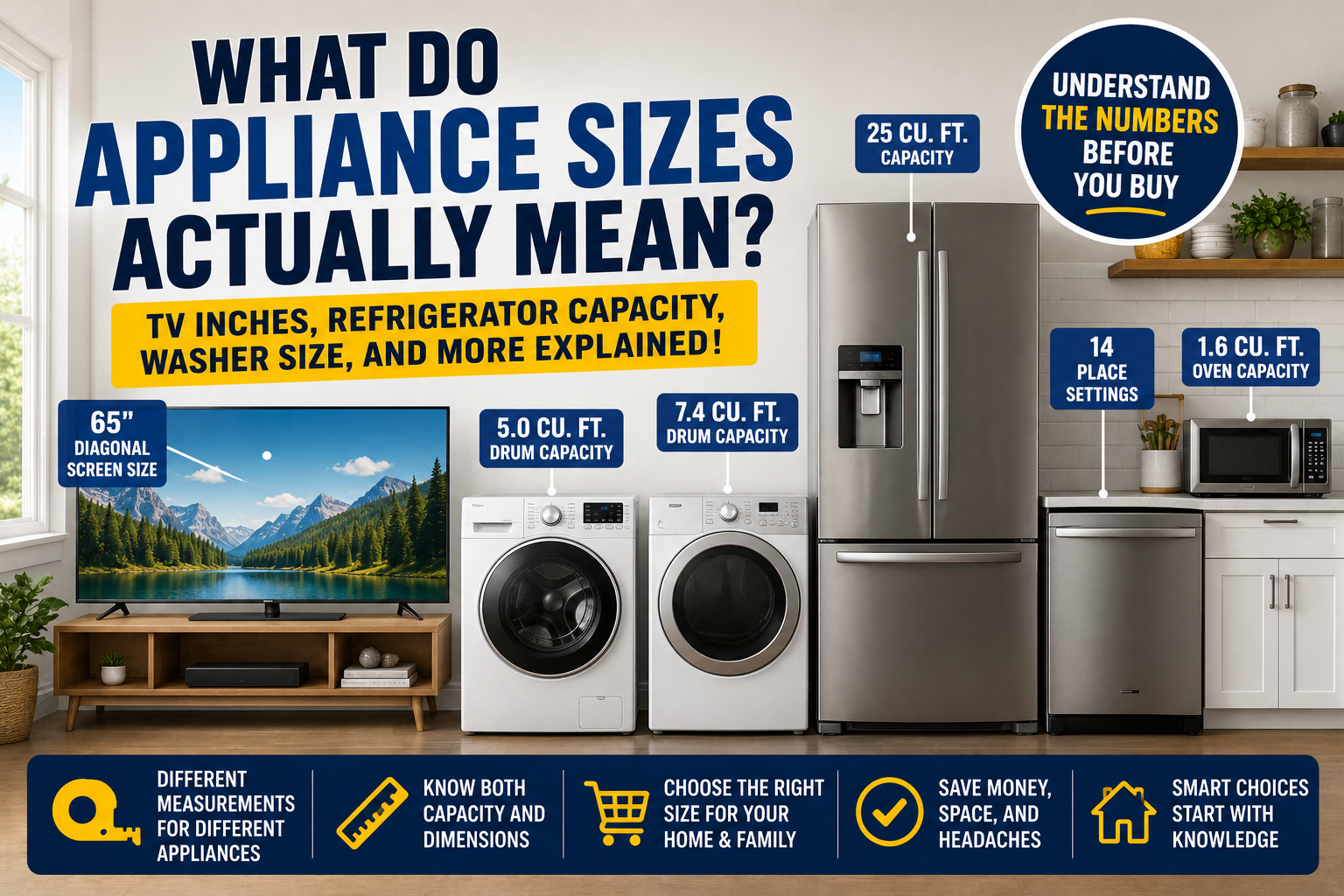
Shopping for a new appliance can feel surprisingly confusing. A 65-inch TV isn’t actually 65 inches wide. A 25-cubic-foot refrigerator doesn’t mean the refrigerator is 25 feet tall. A 5.0-cubic-foot washer isn’t measured the same way as a dishwasher with 14 place settings.
Manufacturers use different measurement systems depending on the appliance, and many shoppers assume these numbers all describe physical dimensions. In reality, they often measure completely different things.
Understanding what these measurements actually mean can help you avoid buying an appliance that’s either too large for your home or too small for your family’s needs.
Quick Answer
Appliance sizes are measured in different ways depending on the product. TVs use the diagonal screen measurement in inches, refrigerators and washers typically use cubic feet to indicate storage or drum capacity, while dishwashers use place settings instead of interior volume. Always check both the appliance’s physical dimensions and its usable capacity before buying.
| Appliance | Size Measurement | What It Actually Means |
|---|---|---|
| Television | Inches | Diagonal screen size |
| Refrigerator | Cubic feet | Interior storage volume |
| Washer | Cubic feet | Drum capacity |
| Dryer | Cubic feet | Drum capacity |
| Dishwasher | Place settings | Number of standard dish sets |
| Microwave | Cubic feet | Oven cavity volume |
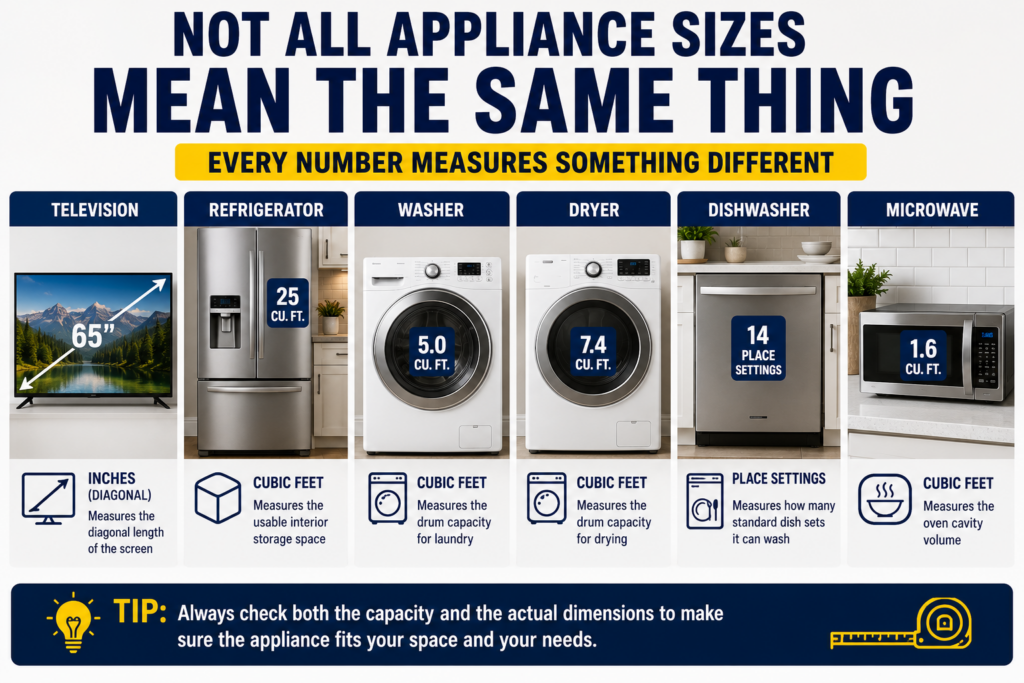
Alt Text: Various home appliances labeled with their different sizing systems including TV inches, refrigerator cubic feet, washer drum size, and dishwasher place settings.
Why Appliance Sizes Use Different Measurements
Every appliance performs a different job, so manufacturers measure the feature that matters most.
A television is primarily about viewing area, making diagonal screen size the most useful specification.
A refrigerator focuses on food storage.
A washing machine is designed around laundry volume.
A dishwasher needs enough room for dishes rather than clothing or groceries.
Because each appliance serves a different purpose, comparing their measurements directly isn’t meaningful.
For example, a 5.0-cubic-foot washer and a 5.0-cubic-foot refrigerator measure entirely different kinds of usable space.
The number alone doesn’t tell you how physically large the appliance is.
TV Inches Don’t Measure Width
Perhaps the most misunderstood appliance measurement is television size.
A 65-inch television measures the distance from one corner of the screen diagonally to the opposite corner.
It does not represent:
- Screen width
- Total height
- Cabinet dimensions
- Wall space required
For example, many people assume upgrading from a 55-inch TV to a 65-inch TV adds only ten inches of width.
In reality, the increase in overall width is often closer to eight or nine inches, depending on the aspect ratio and bezel design.
Before purchasing a television, always verify:
- Overall width
- Overall height
- Stand dimensions
- Required viewing distance
- Wall mounting clearance
The diagonal measurement helps compare viewing size, while the actual dimensions determine whether the TV fits your room.
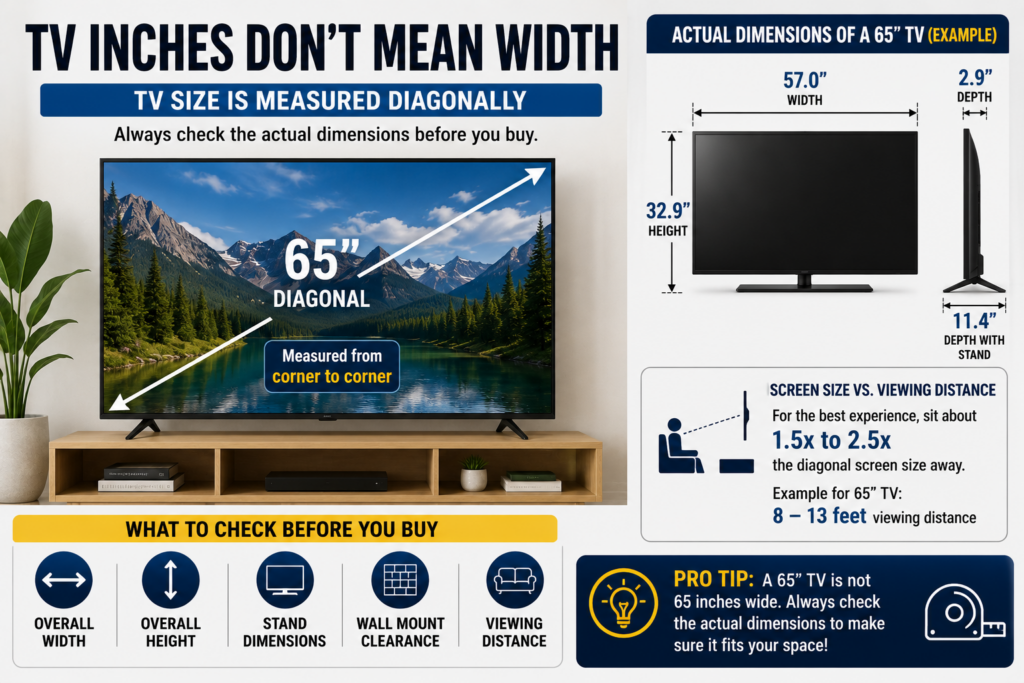
Alt Text: Diagram showing how TV screen size is measured diagonally compared to the actual width and height.
Refrigerator Capacity Is Measured in Cubic Feet
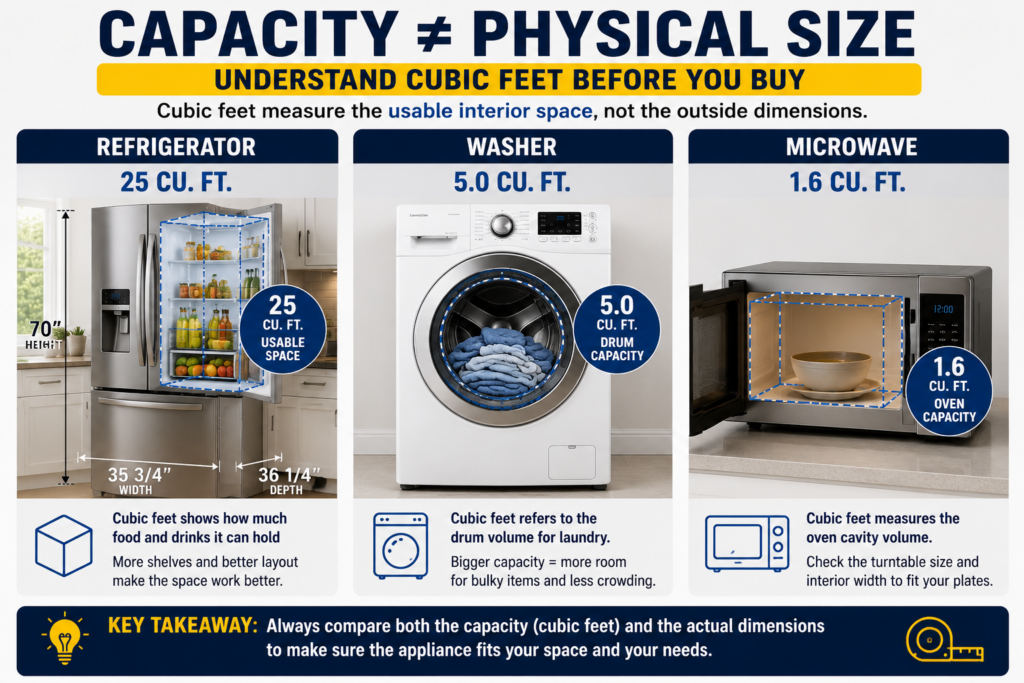
Unlike televisions, refrigerators are measured by interior storage volume.
When you see:
- 18 cubic feet
- 22 cubic feet
- 25 cubic feet
- 28 cubic feet
those numbers estimate how much usable storage space the refrigerator provides.
A larger cubic-foot rating generally means more room for groceries, but it doesn’t guarantee better organization.
Shelf layout, drawer size, door bins, and freezer configuration all affect how practical that space feels.
A family of four may be comfortable with approximately 22 to 25 cubic feet, while smaller households often find 18 to 21 cubic feet sufficient.
Remember that two refrigerators with nearly identical cubic-foot ratings may have noticeably different exterior dimensions.
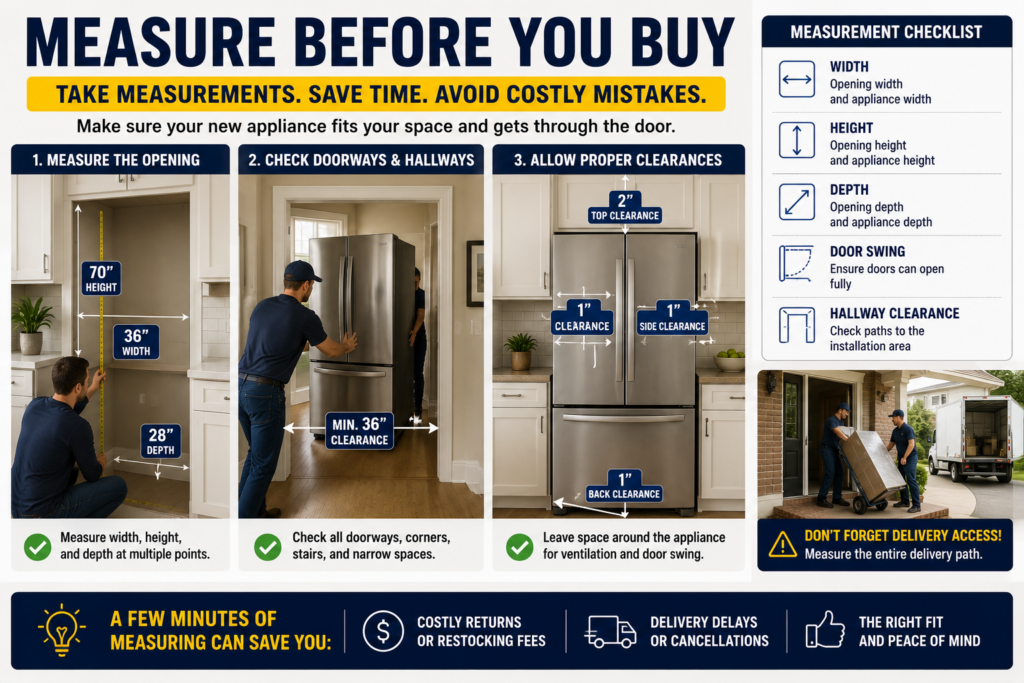
Always measure:
- Cabinet opening
- Door clearance
- Hallways
- Delivery path
- Ventilation space
before ordering.
Washer Drum Size Measures Laundry Capacity
Washers also use cubic feet, but here the measurement refers to drum volume rather than food storage.
Typical capacities include:
- 3.5 cu. ft.
- 4.5 cu. ft.
- 5.0 cu. ft.
- 5.5 cu. ft.
A larger drum allows clothing to tumble more freely, which helps bulky items clean more effectively.
However, bigger isn’t automatically better.
A single person who washes small loads throughout the week may never benefit from a 5.5-cubic-foot washer.
Instead, choose a washer that matches:
- Household size
- Laundry frequency
- Bedding size
- Clothing type
- Dryer capacity
Alt Text: Front-load washer with labeled drum capacity alongside different household laundry loads.
Dryer Capacity Should Match Your Washer
Dryers also use cubic feet, but many buyers overlook an important relationship.
A dryer should generally have slightly more usable drum volume than the washer it accompanies.
That extra space allows warm air to circulate efficiently while drying.
For example:
- 4.5 cu. ft. washer → approximately 6.5–7.0 cu. ft. dryer
- 5.0 cu. ft. washer → approximately 7.0–7.5 cu. ft. dryer
Choosing a much smaller dryer can eliminate the convenience of owning a large-capacity washer because loads may need to be divided before drying.
Dishwasher Capacity Uses Place Settings Instead
Dishwashers measure capacity differently because dishes don’t occupy space the same way clothing does.
Instead of cubic feet, manufacturers use place settings.
One place setting generally includes:
- Dinner plate
- Salad plate
- Bowl
- Cup
- Glass
- Knife
- Fork
- Spoons
Most standard 24-inch dishwashers hold roughly 12 to 16 place settings.
Compact 18-inch models typically accommodate 8 to 10 place settings.
Although this system isn’t perfect—pots and pans take far more room than plates—it provides a useful comparison between models.
Microwave Capacity Can Be Misleading
Microwave ovens also list capacity in cubic feet.
You’ll commonly see:
- 0.7 cu. ft.
- 1.1 cu. ft.
- 1.6 cu. ft.
- 2.0 cu. ft.
However, the number doesn’t always indicate whether your largest dinner plate will fit.
Interior shape, turntable diameter, and door opening size influence usable cooking space just as much as total cavity volume.
Always compare:
- Turntable diameter
- Interior width
- Maximum dish size
- Available countertop space
rather than relying only on cubic feet.
Alt Text: Infographic comparing TV inches, refrigerator capacity, washer drum size, dryer capacity, dishwasher place settings, and microwave cubic feet.
Physical Dimensions Still Matter
Capacity tells you what an appliance can hold.
Physical dimensions determine whether it fits your home.
Before ordering any major appliance, measure:
- Width
- Height
- Depth
- Door swing
- Ventilation clearance
- Stairways
- Hallways
- Entry doors
- Elevator dimensions (if applicable)
Many delivery problems happen because buyers focus only on capacity while forgetting the appliance still has to make it through the front door.
Which Measurement Should Matter Most?
Different appliances require different priorities.
For televisions, prioritize screen size while confirming the overall width.
For refrigerators, combine cubic-foot capacity with cabinet dimensions.
For washers and dryers, balance drum size with your laundry habits.
For dishwashers, look beyond place settings and pay attention to rack flexibility and interior design.
Understanding what each measurement represents helps you compare products more confidently and avoid expensive purchasing mistakes.
FAQ
Is a bigger appliance always better?
Not necessarily. The ideal size depends on your household, available space, and how frequently you use the appliance. Buying significantly larger than necessary may increase cost without providing meaningful benefits.
Why doesn’t a 65-inch TV measure 65 inches across?
Television sizes refer to the diagonal screen measurement, not the width. The actual width depends on the screen’s aspect ratio and bezel design.
Is refrigerator capacity the same as exterior size?
No. Two refrigerators with similar cubic-foot ratings can have different widths, heights, and internal layouts. Always compare both capacity and physical dimensions.
Why are dishwashers measured in place settings instead of cubic feet?
Dishwashers are designed to clean standardized sets of dishes. Place settings provide a more practical comparison than measuring the interior volume alone.
Appliance Size Buying Checklist
- Learn which measurement system each appliance uses.
- Measure your installation space before shopping.
- Check delivery path dimensions throughout your home.
- Compare usable capacity—not just advertised numbers.
- Match washer and dryer capacities.
- Consider your family’s long-term needs.
- Verify door swing and ventilation clearances.
- Read the detailed specification sheet before purchasing.
Related Reading:
• What Refrigerator Capacity Does Your Family Really Need?
• How to Measure for a New Refrigerator Before You Buy: A Complete Homeowner’s Guide
• LG vs Samsung Refrigerators: Reliability, Features, and Value Compared
• Samsung vs Frigidaire Refrigerators: Which Offers Better Value in