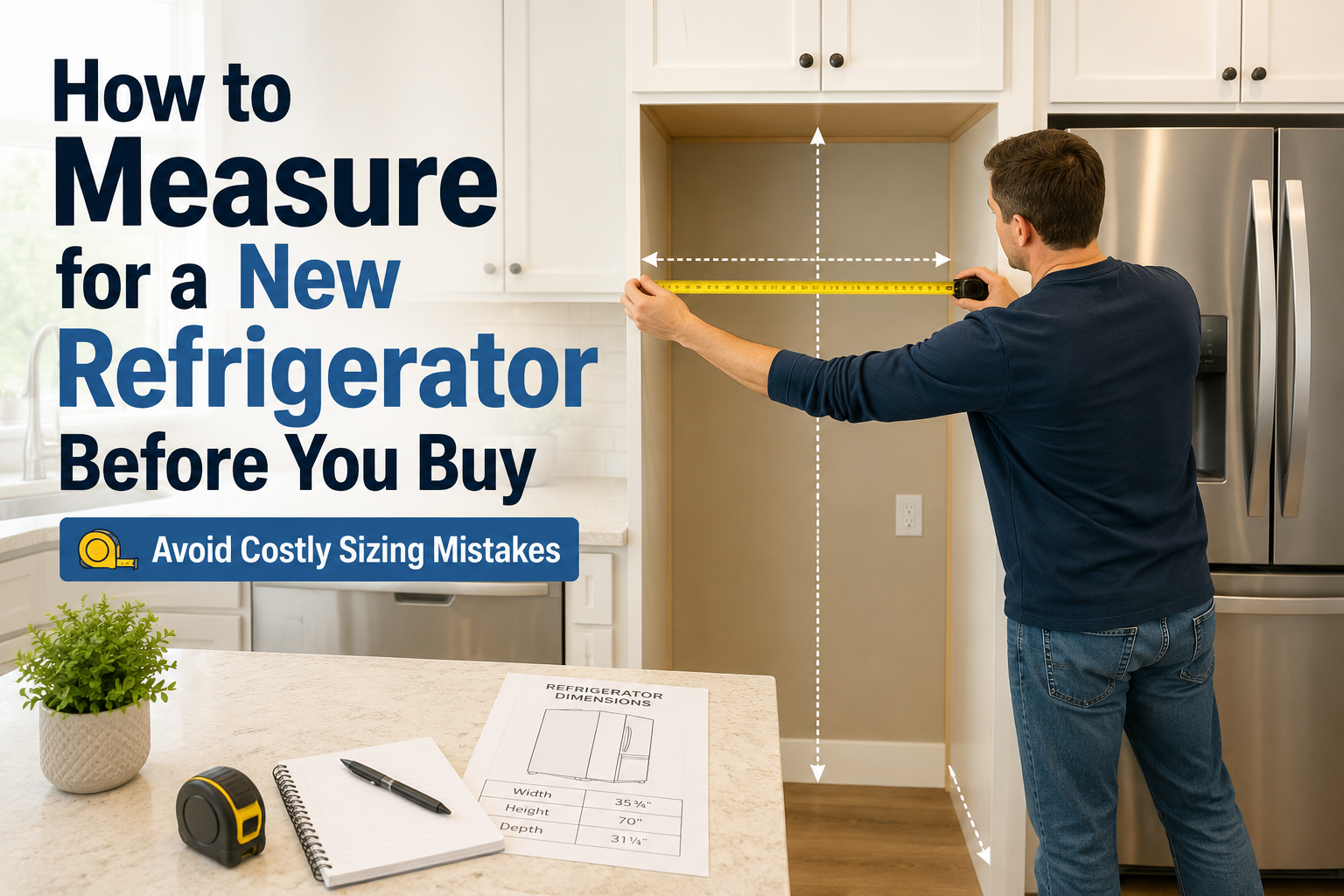
Buying a refrigerator is one of the biggest appliance purchases most homeowners make, yet many people focus on features and finishes before checking whether the appliance will actually fit. Learning how to measure for a new refrigerator before you buy can save hundreds of dollars in delivery fees, return costs, and unexpected kitchen modifications.
A refrigerator that looks perfect online may not fit through your front door, around a hallway corner, or into the cabinet opening. Even if it slides into place, poor clearance around the sides or top can reduce airflow and affect long-term performance.
Before you shop, take a few measurements and compare them with the manufacturer’s installation specifications rather than just the refrigerator’s overall dimensions.
Quick Answer
To measure for a new refrigerator, record the width, height, and depth of the cabinet opening, then measure every doorway, hallway, stairway, and turn between the entrance and the kitchen. Leave enough clearance for ventilation, door swing, and water line connections. Comparing your measurements with the manufacturer’s installation guide helps prevent expensive sizing mistakes.
Why Measuring Matters More Than Most Buyers Expect
Many refrigerator returns happen for one simple reason—the appliance fits the kitchen but never makes it into the house.
Delivery crews often discover problems such as narrow entry doors, low ceilings, tight corners, or kitchen islands that limit maneuvering space. These issues may require removing refrigerator doors, taking off house doors, or even rescheduling delivery.
For a first-time homeowner, spending ten minutes with a tape measure can prevent days of frustration later.
Alt Text:
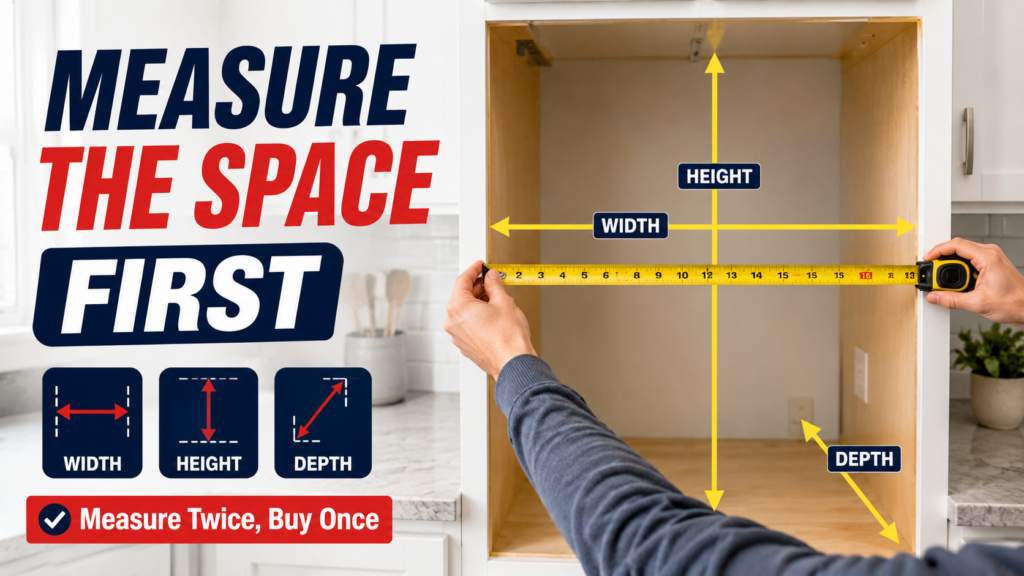
Homeowner measuring a refrigerator cabinet opening with a tape measure before purchasing a new refrigerator.
The Five Measurements You Should Always Take
| Measurement | Why It Matters |
|---|---|
| Cabinet Width | Determines whether the refrigerator fits between cabinets |
| Cabinet Height | Prevents interference with upper cabinets |
| Cabinet Depth | Shows whether the refrigerator will protrude excessively |
| Delivery Path | Ensures the appliance can reach the kitchen |
| Door Clearance | Allows refrigerator doors and drawers to open fully |
Do not rely on the dimensions of your current refrigerator. Older models may have been installed before flooring, cabinets, or countertops were updated.
Instead, measure the available space as it exists today.
Measure the Width
Take three width measurements:
- Near the floor
- At countertop height
- Near the top of the opening
Older homes sometimes have uneven cabinets, and the narrowest measurement is the one that matters.
Measure the Height
Measure from the finished floor to the lowest point underneath the upper cabinet.
If you’re planning to replace flooring later, remember that new flooring can slightly reduce the available height.
Measure the Depth
Depth isn’t simply the distance from the wall.
Consider:
- Cabinet depth
- Countertop overhang
- Baseboards
- Water supply connection
- Refrigerator handles
- Door thickness
Counter-depth refrigerators typically align more closely with surrounding cabinets, while standard-depth models usually extend several inches farther into the kitchen.
Alt Text:
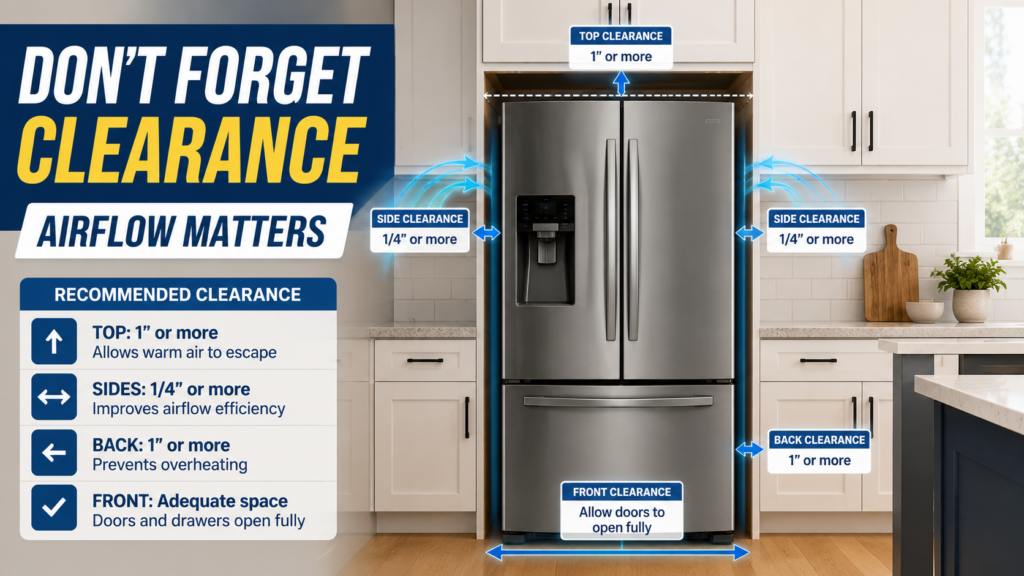
Diagram showing refrigerator width, height, depth, and required ventilation clearance.
Don’t Forget the Required Clearance Space
Manufacturers specify minimum clearance around refrigerators to allow proper airflow.
Although requirements vary by model, many refrigerators need small gaps around the sides, rear, and top for efficient cooling.
Insufficient airflow may cause:
- Longer compressor run times
- Higher electricity usage
- Reduced cooling efficiency
- Increased wear on internal components
Always follow the installation manual rather than assuming every refrigerator requires the same spacing.
Measure the Entire Delivery Route
The refrigerator’s final location isn’t the only area that matters.
Walk from your front entrance to the kitchen while measuring:
- Front door width
- Storm door opening
- Interior doors
- Hallways
- Staircases
- Ceiling height
- Tight corners
- Kitchen island spacing
In apartment buildings, measure elevator dimensions as well.
A budget-conscious buyer replacing an older refrigerator in a small apartment often discovers that the delivery route—not the kitchen opening—is the real limitation.

Alt Text:
Delivery team carefully moving a refrigerator through a narrow hallway inside a home.
Account for Door Swing and Everyday Use
A refrigerator may technically fit the opening but still be inconvenient to use.
Check that the doors can open wide enough to:
- Remove shelves
- Pull out crisper drawers
- Access freezer baskets
- Clean interior compartments
French-door and side-by-side refrigerators generally require different amounts of front clearance than top-freezer models.
If your refrigerator sits beside a wall, verify that the door can swing far enough to fully extend interior drawers.
Water Line and Electrical Considerations
If you’re buying a refrigerator with an ice maker or water dispenser, leave room behind the appliance for the water supply line.
Avoid sharply bending either the water line or power cord when pushing the refrigerator into place.
If a new water connection is needed, professional installation commonly ranges from about $150 to $400, depending on the home’s plumbing layout and local labor rates.
Common Measuring Mistakes
Many sizing problems happen because buyers make one of these errors:
- Measuring only the old refrigerator
- Ignoring door handles
- Forgetting ventilation clearance
- Measuring cabinet exteriors instead of interior openings
- Skipping hallway measurements
- Assuming every manufacturer’s dimensions are measured the same way
Taking a few extra measurements is much easier than arranging a return after delivery.
Alt Text:
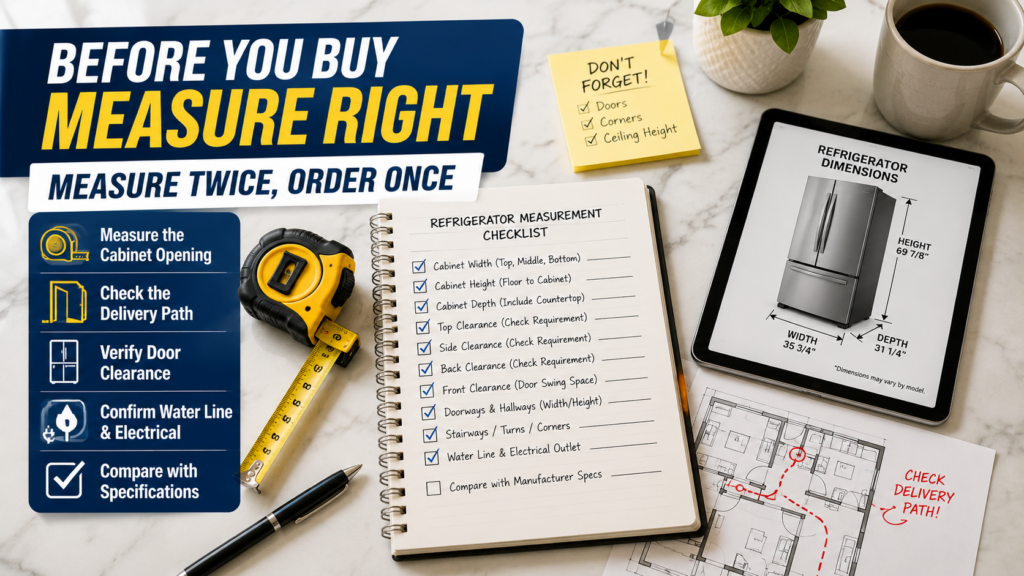
Checklist showing refrigerator measurements including cabinet opening, delivery path, and door clearance.
Before You Order Online
Online shopping makes comparing refrigerators easier than ever, but it also increases the chance of ordering the wrong size.
Before placing an order:
- Compare your measurements with the manufacturer’s installation guide.
- Verify both product dimensions and installation dimensions.
- Confirm whether the doors can be removed during delivery.
- Measure again if your kitchen has recently been remodeled.
- Double-check that the refrigerator can pass through every doorway.
Many retailers also offer pre-delivery measurement services for an additional fee, which may be worthwhile if your home has tight spaces or unusual layouts.
Choosing the Right Size for Your Household
Finding the correct dimensions isn’t just about making the refrigerator fit. It’s also about matching capacity to your lifestyle.
A family of four generally benefits from more storage, but choosing the largest model available isn’t always the best decision if it reduces kitchen workspace or blocks walkways.
Smaller households, condo owners, and apartment residents may find that a counter-depth refrigerator provides a better balance between storage and floor space, even if it offers slightly less interior capacity.
Think about how you use your kitchen every day rather than focusing only on cubic feet.
Final Thoughts
Measuring for a new refrigerator takes only a few minutes, yet it can prevent one of the most common appliance-buying mistakes. By checking the cabinet opening, delivery path, ventilation space, and door clearance before you buy, you’ll greatly reduce the risk of delays, returns, or costly modifications.
The best refrigerator isn’t simply the one with the most features—it’s the one that fits your home comfortably, operates efficiently, and remains practical to use for years to come.
④ FAQ
How much extra space should I leave around a refrigerator?
Always follow the manufacturer’s installation guide. Clearance requirements vary by model, but refrigerators typically need small gaps around the sides, rear, and top to maintain proper airflow.
Can refrigerator doors be removed during delivery?
In many cases, yes. Delivery teams can often remove and reinstall refrigerator doors to fit through narrow openings. However, this depends on the model and the delivery company’s policies.
Is a counter-depth refrigerator easier to fit?
Usually. Counter-depth models are shallower than standard-depth refrigerators, making them easier to integrate into many kitchens. However, you should still measure the cabinet opening and delivery path before purchasing.
Should I measure with or without baseboards?
Measure the actual usable space. Baseboards and trim can reduce available depth, so include them when checking whether the refrigerator will fit.
⑤ Checklist
Refrigerator Measurement Checklist
- □ Measure cabinet width in three locations.
- □ Measure cabinet height from the finished floor.
- □ Measure available cabinet depth.
- □ Confirm manufacturer clearance requirements.
- □ Measure every doorway and hallway on the delivery route.
- □ Check ceiling height and tight corners.
- □ Verify refrigerator door swing space.
- □ Confirm water line and electrical outlet locations.
- □ Compare your measurements with the installation specifications.
- □ Measure everything one final time before placing your order.
Related Reading:
• LG vs Samsung Refrigerators: Reliability, Features, and Value Compared
• Samsung vs Frigidaire Refrigerators: Which Offers Better Value in
• GE vs Whirlpool Refrigerators: Which Lasts Longer in
• Best Refrigerator for Large Families: A Practical Buying Guide for Busy Households
• LG vs GE Refrigerators: Which Brand Is More Reliable for Long-Term Use?