
Shopping for a new washing machine often starts with brand names, smart features, and energy ratings. Yet one specification has a bigger impact on everyday convenience than many buyers realize: washer drum size.
A drum that’s too small can leave you washing multiple loads every week, while one that’s much larger than your needs may cost more without providing meaningful benefits.
The best washer isn’t simply the biggest one you can afford. It’s the model with enough capacity to match your family’s laundry habits, clothing types, and available laundry space.
Quick Answer
Most households should choose a washer based on both family size and laundry habits. A 4.5 to 5.0 cubic-foot drum works well for most families of three or four, while singles and couples are often comfortable with 3.5 to 4.5 cubic feet. Large households or those washing bulky bedding regularly may benefit from 5.0 cubic feet or larger.
| Household | Recommended Drum Size |
|---|---|
| 1 Person | 3.0–3.8 cu. ft. |
| 2 People | 3.8–4.5 cu. ft. |
| 3–4 People | 4.5–5.0 cu. ft. |
| 5+ People | 5.0–6.0+ cu. ft. |
Alt Text: Washing machines with small, medium, and large drum capacities displayed side by side.
Drum Capacity Is About More Than Family Size
Family size provides a useful starting point, but it shouldn’t be the only factor.
Think about how your household actually handles laundry.
For example:
- Do you wash clothes every day or only on weekends?
- Do you frequently wash comforters?
- Are there young children creating extra laundry?
- Do you wear bulky work clothes?
- Do you play sports that generate multiple uniforms each week?
A family of two who exercises daily and washes towels frequently may actually need a larger washer than a family of four that does laundry every evening.
Your laundry routine matters just as much as the number of people in your home.
Understanding Cubic Feet
Washer capacity in the United States is measured in cubic feet, not pounds.
Generally speaking:
- Around 3.5 cu. ft. suits light weekly laundry.
- Around 4.5 cu. ft. handles average household needs comfortably.
- 5.0 cu. ft. or larger accommodates bulky loads with fewer wash cycles.
Keep in mind that usable space varies between manufacturers. Two washers listed at 4.8 cubic feet may have different drum designs and loading efficiency.
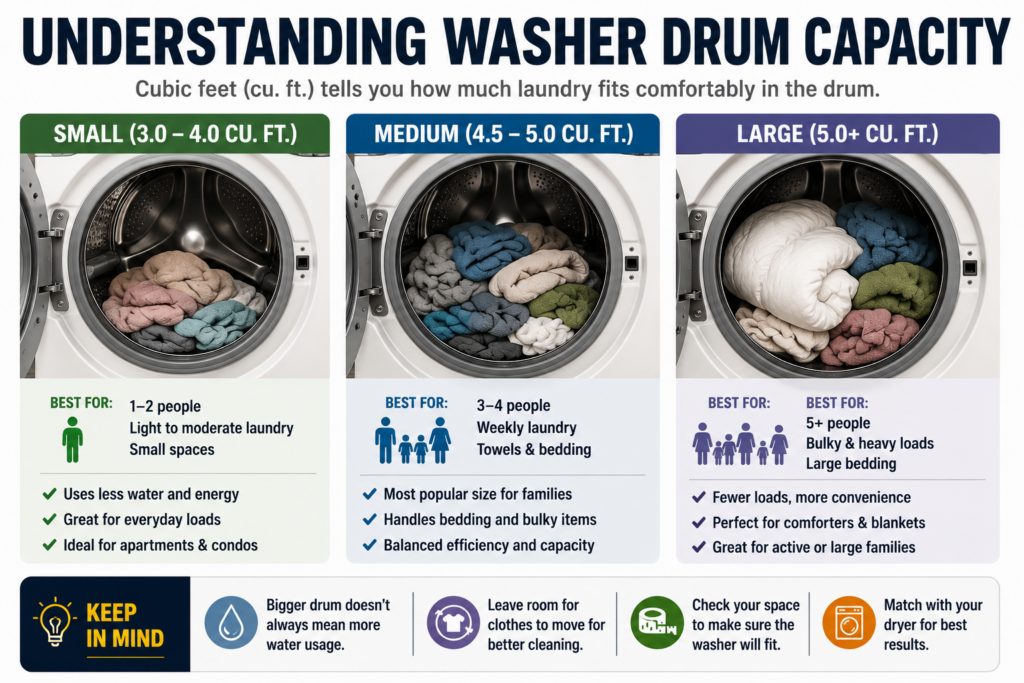
Alt Text: Cross-section comparison of different washer drum capacities with clothing loads.
When a Larger Drum Makes Sense
A larger drum isn’t simply about fitting more clothing.
It also allows garments to move more freely during washing.
That extra room can improve cleaning performance for bulky loads such as:
- King-size comforters
- Large blankets
- Dog bedding
- Sleeping bags
- Heavy towels
- Winter jackets
For a family of four that washes bedding every week, a washer around 5.0 cubic feet often reduces the number of loads needed while giving large items enough room to circulate properly.
If oversized bedding is something you wash only once or twice a year, however, paying extra for maximum capacity may not be worthwhile.
Bigger Isn’t Always Better
Many shoppers assume the largest washer is automatically the smartest purchase.
That’s not always true.
Very large washers may:
- Cost more initially.
- Require additional laundry room space.
- Encourage overloading if users continue adding more clothes.
- Increase drying time when paired with a smaller dryer.
- Be unnecessary for households with minimal weekly laundry.
The goal is not to fill the drum to its maximum every cycle.
Instead, choose a size that allows typical loads to wash efficiently with room for clothing to tumble freely.
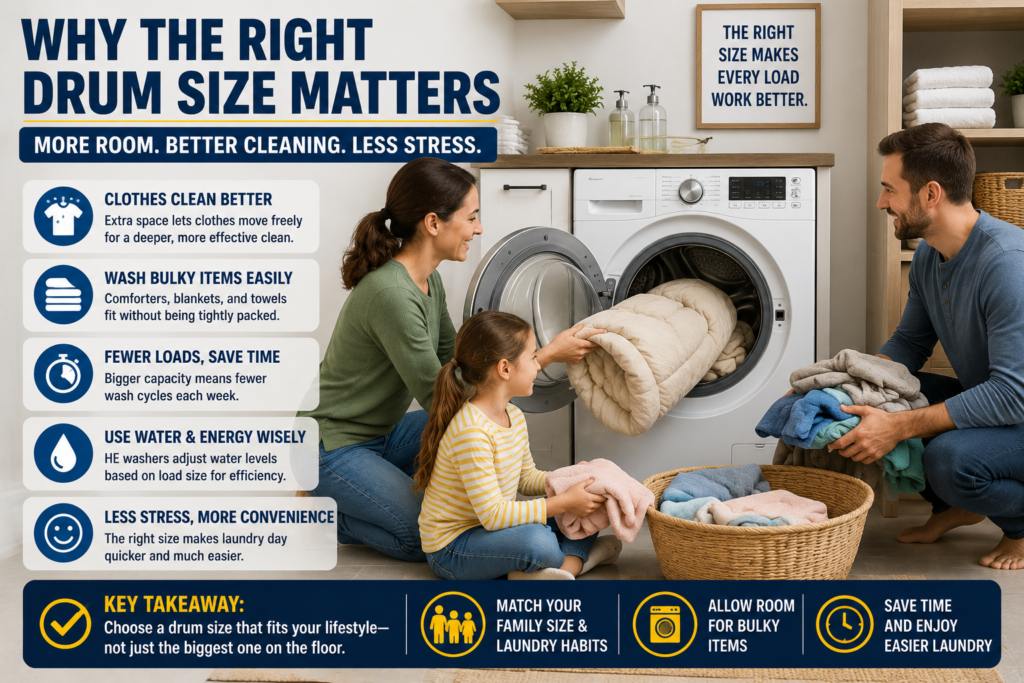
Alt Text: Family loading towels and bedding into a large-capacity front-load washing machine.
Match Your Washer to Your Dryer
One common mistake is purchasing a large washer while keeping an older, smaller dryer.
A washer capable of cleaning an oversized load doesn’t automatically mean the dryer can handle it.
Ideally:
- Washer and dryer capacities should complement each other.
- The dryer should have slightly more usable volume than the washer.
- Large comforters should fit comfortably in both appliances.
If your dryer is significantly smaller, you may end up splitting loads before drying, eliminating much of the benefit of the larger washer.
Front-Load vs. Top-Load Capacity
Front-load and top-load washers can advertise similar drum sizes while handling laundry somewhat differently.
Front-load models generally make more efficient use of drum space because clothes tumble through a horizontal drum.
Many high-efficiency top-load washers also provide excellent capacity, although models with an agitator may have slightly less usable room for bulky items.
Instead of focusing only on cubic feet, compare:
- Interior drum shape
- Agitator vs. impeller design
- Maximum load recommendations
- Bedding cycle performance
- Manufacturer guidance for bulky items
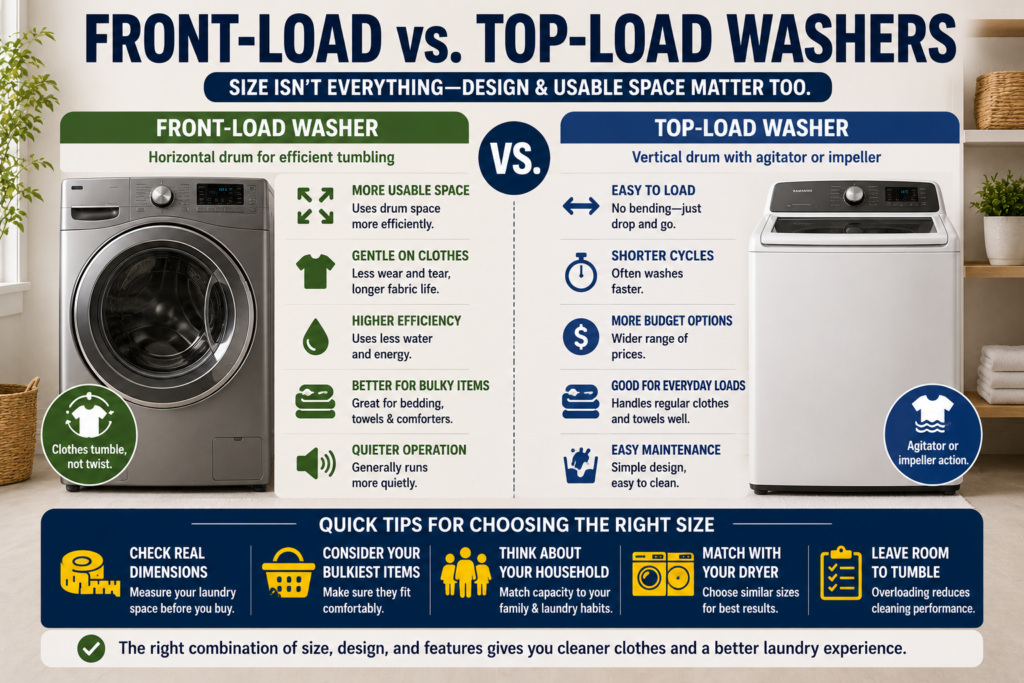
Alt Text: Front-load and top-load washers compared with labeled drum capacities.
Think About Your Future Needs
Buying a washer is usually a long-term investment.
Before choosing capacity, consider whether your household may change during the next several years.
A first-time homeowner planning to start a family may find that moving from a 4.0-cubic-foot washer to a 4.8-cubic-foot model provides enough extra flexibility without dramatically increasing cost or space requirements.
Likewise, someone nearing retirement whose children have moved out may not benefit from purchasing the largest available machine.
Signs Your Current Washer Is Too Small
Your existing washer may already indicate it’s time for a larger drum.
Common signs include:
- Multiple laundry loads every day.
- Bedding barely fitting inside the drum.
- Clothes packed tightly with little room to move.
- Towels requiring a second wash because they weren’t cleaned thoroughly.
- Frequent trips to a laundromat for comforters.
If these situations occur regularly, increasing washer capacity during your next purchase can save both time and effort.
Choosing the Right Size for Everyday Living
Rather than selecting the biggest washer available, choose one that comfortably handles your busiest normal laundry day.
A properly sized drum reduces the number of loads each week, improves washing performance, and helps bulky items clean more evenly.
For most American households, a washer between 4.5 and 5.0 cubic feet strikes an excellent balance between efficiency, flexibility, purchase price, and long-term convenience.
FAQ
Is a 4.5 cubic-foot washer large enough for a family of four?
Yes. For most families of four, a 4.5 to 5.0 cubic-foot washer provides enough capacity for everyday clothing, towels, and weekly bedding. Households washing oversized comforters frequently may prefer a slightly larger model.
Can a king-size comforter fit in every large washer?
Not necessarily. Always check the manufacturer’s recommendations. Drum design and comforter thickness can affect whether oversized bedding fits properly.
Does a larger washer use more water?
Modern high-efficiency washers adjust water levels based on the load. A larger machine does not always use significantly more water when washing smaller loads.
Should I buy the largest washer I can afford?
Only if your household regularly needs the extra capacity. Otherwise, choose a washer that matches your typical laundry volume and available laundry space.
Washer Drum Size Checklist
- Count how many people generate laundry each week.
- Consider how often you wash clothes.
- Think about bulky items like comforters and blankets.
- Compare drum capacity in cubic feet—not just model size.
- Make sure your dryer can handle similar load sizes.
- Measure your laundry room before purchasing.
- Review manufacturer recommendations for bedding loads.
- Choose capacity based on your busiest normal week rather than occasional oversized loads.
Related Reading:
• How to Measure for a New Dryer: A Complete Step-by-Step Guide
• How to Measure for a New Washing Machine: A Complete Step-by-Step Guide
• Whirlpool or Maytag Washer? Reliability, Repairs, and Value Compared
• LG vs Samsung Washing Machines: Best Choice for Big Families
• LG vs Maytag Dryers: Reliability, Repair Costs, and Everyday Use