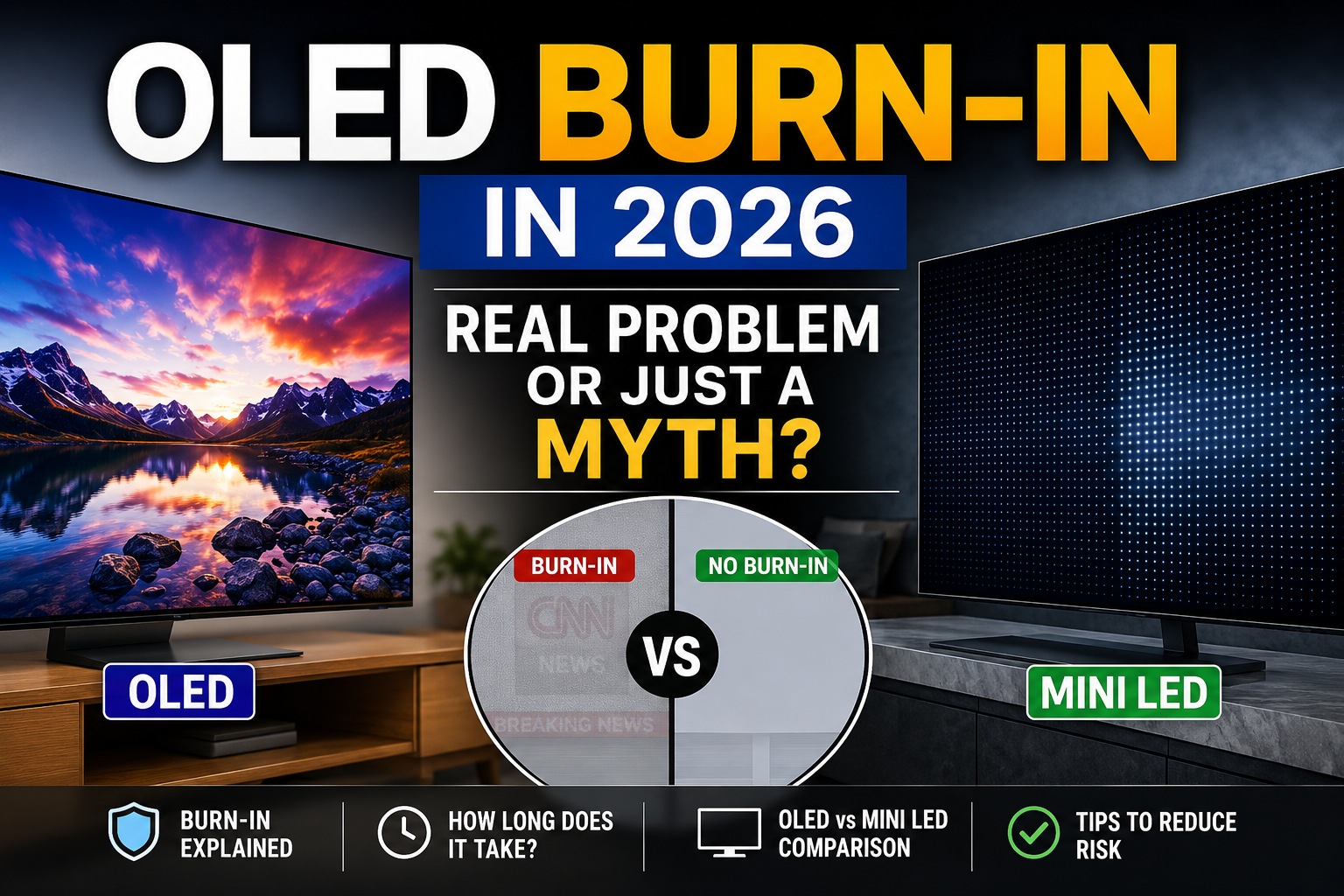
OLED Burn-In in 2026: Is It Still a Problem?
If you’re shopping for a new TV in 2026, you’ve probably heard concerns about OLED burn-in.
Some buyers worry that OLED TVs can develop permanent image retention after a few years, while others claim modern OLED technology has completely solved the problem.
So what’s the truth?
The reality is somewhere in the middle. OLED burn-in is possible, but for most users it is far less common than it was years ago. In this guide, we’ll explain what OLED burn-in really is, how likely it is to happen, and whether it should influence your next TV purchase.
What Is OLED Burn-In?
OLED TVs use self-emitting pixels, meaning every pixel creates its own light instead of relying on a separate backlight.
Because individual pixels age over time, areas of the screen displaying static images for long periods can wear unevenly. This uneven wear may eventually leave a faint permanent image on the screen, commonly known as burn-in.
Examples include:
- News channel logos
- Sports scoreboards
- Video game HUDs
- Desktop taskbars
- Static menus
Unlike temporary image retention, true burn-in does not disappear on its own.
Is OLED Burn-In Still a Problem in 2026?
For most buyers, the answer is no.
Modern OLED TVs include multiple technologies designed to reduce burn-in risk significantly.
Common Burn-In Protection Features
- Pixel Shift
- Logo Detection
- Pixel Refresh
- Screen Saver Functions
- Automatic Brightness Limiting (ABL)
These features work in the background to reduce uneven pixel wear and help extend panel lifespan.
As a result, OLED TVs released in 2026 are much more resistant to burn-in than earlier generations.
How Long Does It Take for OLED Burn-In to Appear?
Most users will never experience burn-in during normal ownership.
Burn-in usually occurs after thousands of hours displaying the same static content, such as news logos, gaming interfaces, or desktop toolbars.
For people who mainly watch movies, TV shows, and streaming services, burn-in is unlikely to become noticeable before they upgrade to a newer television.
Who Should Still Be Concerned About Burn-In?
Although burn-in is less common today, certain usage patterns can increase the risk.
Heavy News Viewers
Watching channels with permanent logos and scrolling tickers for many hours every day may increase long-term burn-in risk.
Examples include:
- CNN
- FOX News
- MSNBC
- CNBC
Hardcore Gamers
Playing the same game for thousands of hours can create uneven wear in areas where health bars, maps, or scoreboards remain visible.
Examples include:
- EA Sports FC
- NBA 2K
- Call of Duty
- MMORPG titles
PC Users
Using an OLED TV as a computer monitor exposes the screen to static elements such as:
- Taskbars
- Browser tabs
- Application menus
- Desktop icons
This is generally considered one of the higher-risk scenarios for burn-in.
Who Probably Doesn’t Need to Worry?
Most OLED buyers fall into this category.
Streaming Users
If you primarily watch content through services such as:
- Netflix
- Disney+
- Prime Video
- Hulu
- Apple TV+
burn-in is extremely unlikely to become a problem.
Movie Enthusiasts
Movies constantly change scenes and rarely display static elements long enough to create uneven wear.
Average Households
Most families replace their TVs long before burn-in becomes noticeable.
OLED vs Mini LED: Burn-In Comparison
| Feature | OLED | Mini LED |
|---|---|---|
| Burn-In Risk | Possible | None |
| Black Levels | Excellent | Very Good |
| Contrast | Excellent | Very Good |
| HDR Performance | Excellent | Excellent |
| Gaming Experience | Excellent | Very Good |
| Long-Term Stability | Very Good | Excellent |
Mini LED completely eliminates burn-in concerns.
However, OLED still delivers superior black levels, better contrast, and a more cinematic viewing experience.
Why Many Americans Still Choose OLED
Despite years of discussion about burn-in, OLED TV sales continue to grow in the United States.
Popular models include:
- LG C5 OLED
- LG G5 OLED
- Samsung S95F OLED
- Sony BRAVIA 8 OLED
Most owners report that OLED picture quality is far more noticeable than any potential burn-in concerns.
For many buyers, the visual advantages easily outweigh the risks.
How to Reduce Burn-In Risk
Avoid Maximum Brightness All Day
Running a TV at maximum brightness continuously can accelerate pixel wear.
Let Pixel Refresh Complete
Most OLED TVs automatically perform maintenance cycles after use.
Avoid unplugging the TV immediately after turning it off.
Limit Static Content
Try not to leave:
- News channels
- Pause screens
- Desktop screens
displayed for long periods.
Keep Protection Features Enabled
Many users disable built-in protection features without realizing their importance.
Leaving them enabled helps maximize panel lifespan.
FAQ
Can OLED Burn-In Be Fixed?
Permanent burn-in usually cannot be completely removed.
However, temporary image retention often disappears after running the TV’s pixel refresh feature.
Is OLED Burn-In Covered by Warranty?
Coverage depends on the manufacturer and region.
Some brands provide limited coverage, while others consider burn-in to be normal panel wear.
Always review warranty details before purchasing.
Should Gamers Avoid OLED TVs?
Not at all.
Modern OLED TVs include multiple burn-in protection technologies and are widely considered among the best gaming displays available.
The risk mainly affects users who play the same game with static HUD elements for thousands of hours.
Final Verdict
OLED burn-in is possible, but for most buyers in 2026 it should not be a deciding factor.
Choose OLED if you:
- Want the best picture quality available
- Watch movies and streaming content regularly
- Enjoy gaming
- Value perfect black levels and contrast
Consider Mini LED if you:
- Watch news channels all day
- Use your TV as a computer monitor
- Want zero burn-in risk
For the average American household, OLED remains one of the best TV technologies available today. The picture quality benefits are usually far more noticeable than the small possibility of burn-in.
Related Reading:
• Mini LED vs OLED: Which TV Technology Is Better in 2026?
• Samsung TV vs Sony TV: Which Brand Is Better in 2026?
• Samsung TV vs LG TV: Which Brand Is Better in 2026?
• 65 vs 75 Inch TV: Which Size Is Best for Your Room? (2026 TV Size Guide)
• TV Size Guide 2026: Best Viewing Distance for 55, 65, 75 and 85 Inch TVs