Signs Your Refrigerator Is Costing More Than It’s Worth
Meta Description
Is your refrigerator costing more than it’s worth? Learn the warning signs that indicate rising energy bills, expensive repairs, and declining performance so you can decide whether it’s time to repair or replace your refrigerator.
Your refrigerator is one of the few appliances that runs 24 hours a day, every day of the year. Because it works continuously, even small problems can slowly turn into expensive ones. Higher electricity bills, frequent repairs, spoiled food, and constant compressor operation may all be signs that keeping your current refrigerator is costing you more than replacing it.
Many homeowners continue repairing an aging refrigerator simply because it still cools. However, once maintenance costs and energy consumption begin adding up, hanging onto an old appliance may no longer be the most economical choice.
Quick Answer
If your refrigerator requires frequent repairs, uses noticeably more electricity, struggles to maintain safe temperatures, or costs hundreds of dollars to fix every few years, it may be costing more than it’s worth. Comparing repair expenses, energy costs, and the refrigerator’s age can help determine whether replacement is the smarter financial decision.

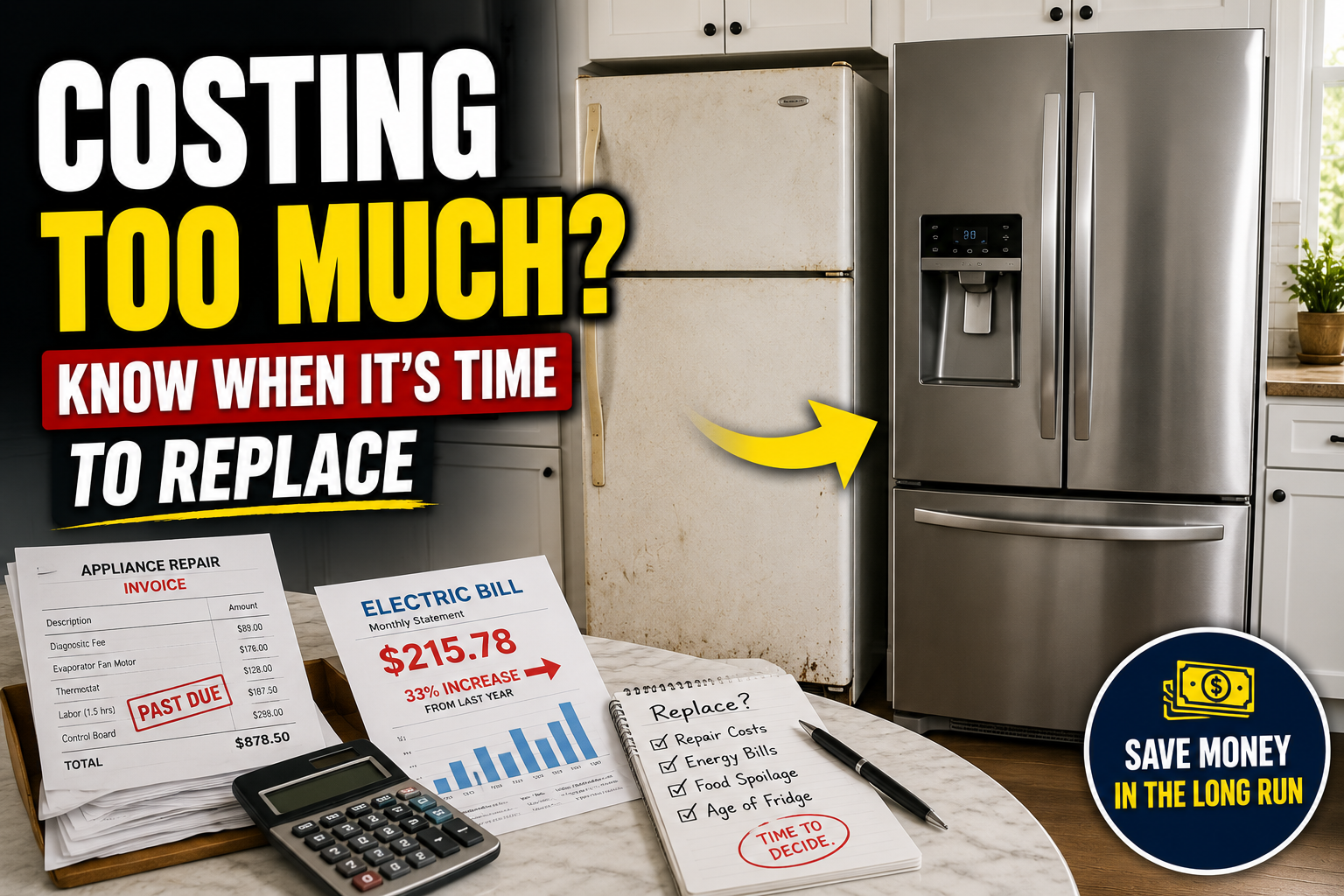
Alt Text: Older refrigerator with rising repair bills and increasing energy costs.
Repair Bills Keep Coming Back
One repair isn’t necessarily a reason to replace a refrigerator.
The bigger concern is when repairs become a regular expense. Replacing an ice maker one year, a control board the next, and then dealing with a compressor issue soon afterward usually indicates the appliance is reaching the end of its reliable service life.
Instead of looking at each repair individually, consider the total amount you’ve spent during the past two or three years.
If repair costs continue increasing, replacing the refrigerator may become the more economical long-term choice.
Your Electricity Bill Has Gradually Increased
Older refrigerators often consume considerably more electricity than newer models.
Even if monthly increases seem small, the extra energy usage accumulates over many years.
Signs that electricity use may be increasing include:
- Longer compressor run times
- Condenser coils that stay excessively hot
- Worn door seals allowing cold air to escape
- Poor insulation caused by age
- Older, less efficient compressor technology
If your utility bills have steadily increased without major lifestyle changes, your refrigerator could be contributing more than you realize.

Alt Text: Comparison between an older refrigerator using more electricity and a newer energy-efficient model.
Food Doesn’t Stay Fresh as Long
One of the earliest warning signs isn’t always obvious.
You may notice milk spoiling earlier than expected, vegetables losing freshness faster, or frozen foods developing freezer burn more frequently.
These symptoms often indicate unstable internal temperatures.
The refrigerator may still feel cold, but inconsistent cooling forces the compressor to work harder while reducing food preservation.
Over time, food waste becomes another hidden ownership cost.
The Compressor Runs Almost Constantly
A healthy refrigerator cycles on and off throughout the day.
If the compressor rarely stops running, something is causing excessive workload.
Possible reasons include:
- Dirty condenser coils
- Refrigerant problems
- Failing compressor
- Poor door seal
- Incorrect temperature settings
- Internal component wear
Running continuously increases electricity consumption and accelerates wear on expensive components.

Alt Text: Refrigerator compressor operating continuously while consuming excessive electricity.
It’s More Than 12 to 15 Years Old
Age alone doesn’t mean immediate replacement, but it deserves consideration.
Many refrigerators continue operating beyond 15 years, yet efficiency and reliability often decline as major components wear out.
Newer refrigerators generally offer:
- Better insulation
- More efficient compressors
- Lower electricity consumption
- Improved temperature control
- Quieter operation
If your refrigerator has already reached this age range, investing hundreds of dollars in another repair deserves careful evaluation.
Repairs Cost Nearly Half the Price of Replacement
A practical guideline many appliance professionals use is the 50% rule.
If repairing your refrigerator costs approximately half the price of purchasing a comparable replacement, replacement is often the better long-term investment.
For example:
- Repair estimate: $700
- Comparable new refrigerator: $1,400
In situations like this, putting more money into an aging appliance may not provide good value.

Alt Text: Homeowner comparing refrigerator repair costs with the price of a new refrigerator.
Hidden Costs Many Homeowners Forget
Repair invoices aren’t the only expenses worth considering.
Older refrigerators can also cost money through:
- Higher electricity bills
- Food spoilage
- Emergency repair visits
- Lost time waiting for service
- Reduced home convenience
These indirect costs often make an older refrigerator more expensive than expected.
When Replacement Makes Better Financial Sense
Replacing a refrigerator becomes easier to justify when several warning signs occur together.
Consider replacement if your refrigerator:
- Is over 12–15 years old.
- Needs major repairs repeatedly.
- Runs almost constantly.
- Struggles to maintain consistent temperatures.
- Causes noticeably higher energy bills.
- Requires repairs approaching half the cost of a comparable new model.
Replacing the appliance before a complete failure also gives you time to compare models instead of making a rushed purchase during an emergency.
Frequently Asked Questions
How long should a refrigerator normally last?
Most refrigerators provide reliable service for about 10 to 15 years, although proper maintenance may extend their lifespan.
Is it worth repairing a refrigerator that’s 15 years old?
It depends on the repair cost. Minor repairs may still be worthwhile, but expensive compressor or sealed-system repairs often make replacement the better investment.
Can an old refrigerator really increase my electric bill?
Yes. Aging compressors, worn seals, and declining efficiency can noticeably increase electricity consumption compared with newer models.
What’s the biggest sign it’s time to replace a refrigerator?
Repeated expensive repairs combined with higher energy use and inconsistent cooling usually indicate replacement is the more economical choice.
Refrigerator Replacement Checklist
- Compare repair estimates with the cost of a similar new refrigerator.
- Review your electricity bills over the past 12 months.
- Check the refrigerator’s age and warranty status.
- Inspect door gaskets, condenser coils, and compressor performance.
- Consider food spoilage and other hidden ownership costs.
- Replace the refrigerator if multiple warning signs appear together rather than waiting for complete failure.
Related Reading:
• Should You Buy an Extended Warranty for a Refrigerator? A Smart Buyer’s Guide
• Why Your Electric Bill Increased After Buying a New Refrigerator (And How to Lower It)
• Refrigerator Water Filter Replacement Guide: When to Replace It and How to Do It Right
• Refrigerator Water Dispenser Not Working? 8 Common Causes and Easy Fixes
• Why Is My Freezer Icing Up? Common Causes, Easy Fixes, and When to Worry